

Testing Hunting Gear: How to Judge Bow Slings in the Field
Learn how hunting gear is tested in real field conditions, what to check in a compound bow sling, and how to judge durability before you buy.

In this article
Quick Summary
Testing hunting gear means running it through repeatable field conditions, such as a fixed one-mile route with climbs and brush, and scoring it on security, comfort, release and attachment stability. Repeat the test on at least three separate days and log every result. Inspect cords and knots before and after each hunt.
- Fix the bow, pack, route and conditions so every product is tested the same way.
- Score security, comfort, release and attachment stability on a one-to-five scale with a note for each.
- Test the release with bare hands and with gloves, five times each.
- Repeat the full routine on at least three separate days to reveal wear.
- Check reviews for detailed use reports rather than the star average alone.
Table of Contents
- Why Testing Hunting Gear in the Field Matters
- Hunting Gear Field Test Methods You Can Run Yourself
- Testing a Compound Bow Sling: Security, Comfort and Hands-Free Carry
- Durability, Strength and Weight Capacity: What to Inspect
- Testing Hunting Gear Online: Reviews, Feedback and Red Flags
- Becoming a Hunting Product Tester: What Legitimate Programs Look Like
- Booking Your Backpack Bow Sling Test Run
- Frequently Asked Questions
Why Testing Hunting Gear in the Field Matters
Testing hunting gear in the field shows you how it performs when a bow is heavy, the ground is steep and your hands are cold. A bow sling that looks solid on a shop counter can slip, rub or fail once you are scrambling uphill with a loaded pack. Field testing exposes those weaknesses before they cost you a shot or a bow.
Most product pages describe features. Few explain how a sling holds up after ten miles of brush, repeated drops and daily wear. That gap is why hunters increasingly judge gear on real use rather than marketing copy. At LDH Outdoors, we build our Backpack Bow Sling for exactly this kind of field scrutiny, and we want you to test it the same way you would test any piece of kit.
A useful test answers three questions: Does it stay put under load? Is it comfortable over distance? Does it release quickly and cleanly when you need your bow? If you can answer those with confidence, the gear has earned a place in your pack.
Hunting Gear Field Test Methods You Can Run Yourself
A fair field test depends on consistent conditions. If every product is judged on different terrain, with different loads and different days, the results cannot be compared. The routine below is built so that any two products you evaluate can be placed side by side.
Start by fixing the variables. Use the same bow or a bow of the same weight, the same pack or harness, and the same route for every product. A route of roughly one mile with a mix of flat ground, a short climb of about 100 feet, and a section of brush gives you a repeatable baseline. Record the date, temperature, footwear and approximate pack load so you can explain any differences later.
Score each product on four criteria, using a simple one-to-five scale for each: security under load (does the bow stay seated through climbing, stepping and kneeling), comfort over distance (pressure points or shifting after the full route), release quality (does the bow fall free without snagging, including with cold or gloved hands), and attachment stability (does the connection hold or creep after each segment). Write a one-line note beside each score explaining what you saw, not just the number.
Test the release separately, because it is the criterion most often overlooked. Lift the weight off the sling and confirm the bow drops cleanly. Repeat the release five times with bare hands and five times with gloves. A product that scores well only with bare hands has a real limitation that matters in late-season cold.
Repeat the full routine on at least three separate days. Many problems, such as stretched cordage, loosening knots or fraying at contact points, appear only after repeated use. Keep the same log for every product so that a change over time is visible rather than remembered.
State your limitations alongside your results. A personal test on one bow, one pack and one terrain type is useful evidence, but it is not a laboratory measurement. Note the conditions where your findings may not apply, such as very heavy bows, different pack designs or terrain you did not test. Readers can then decide how far your conclusions transfer to their own setup.
Testing a Compound Bow Sling: Security, Comfort and Hands-Free Carry
A compound bow sling has three jobs: hold the bow securely, keep it comfortable on the body and release cleanly. Test each one deliberately rather than assuming the design handles them all.
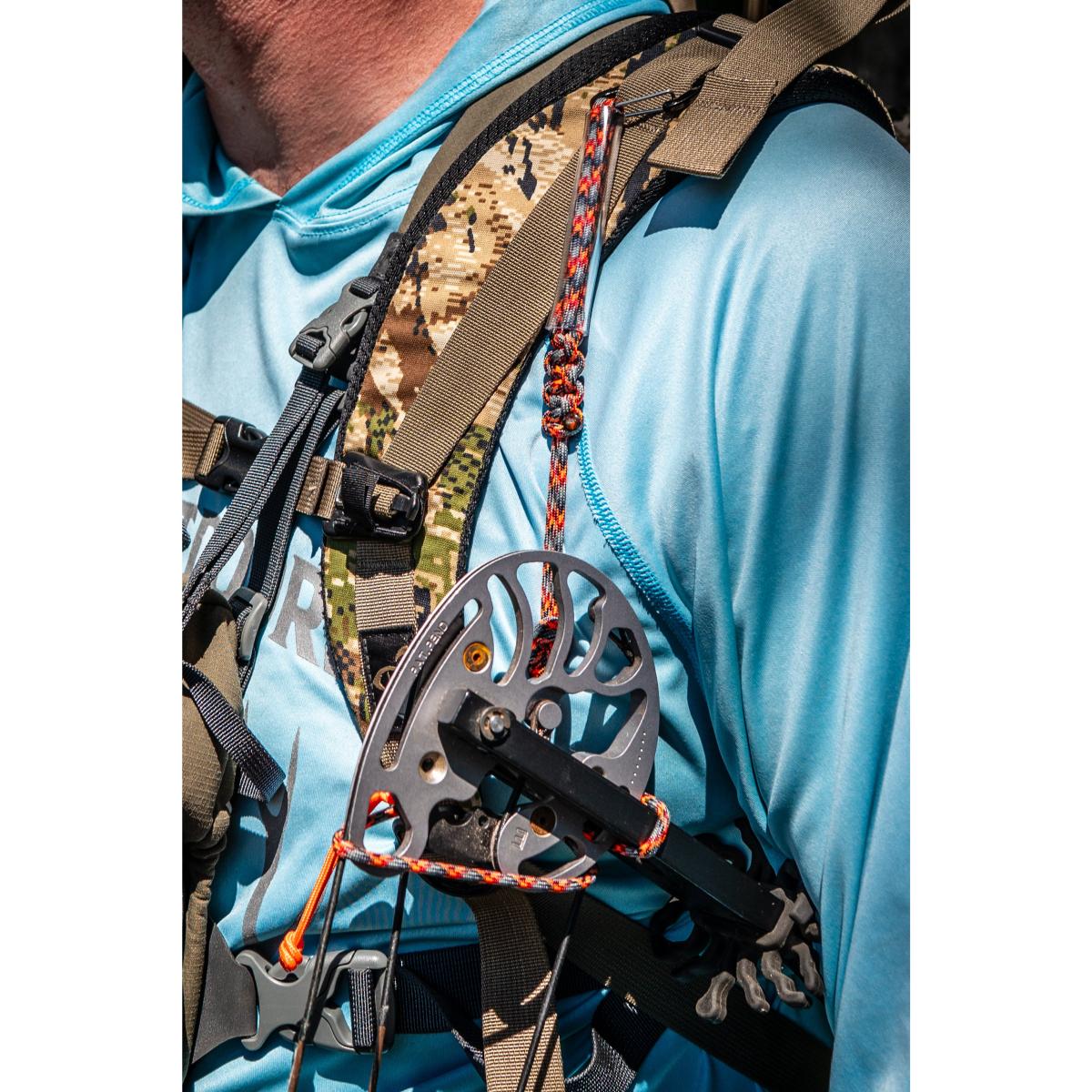
For security, hang your bow from the sling and move the way you would on a hunt: climb a short slope, step over a log, kneel and stand. The bow should stay seated without swinging into brush or touching the cams and strings. Confirm that behavior in your own setup.
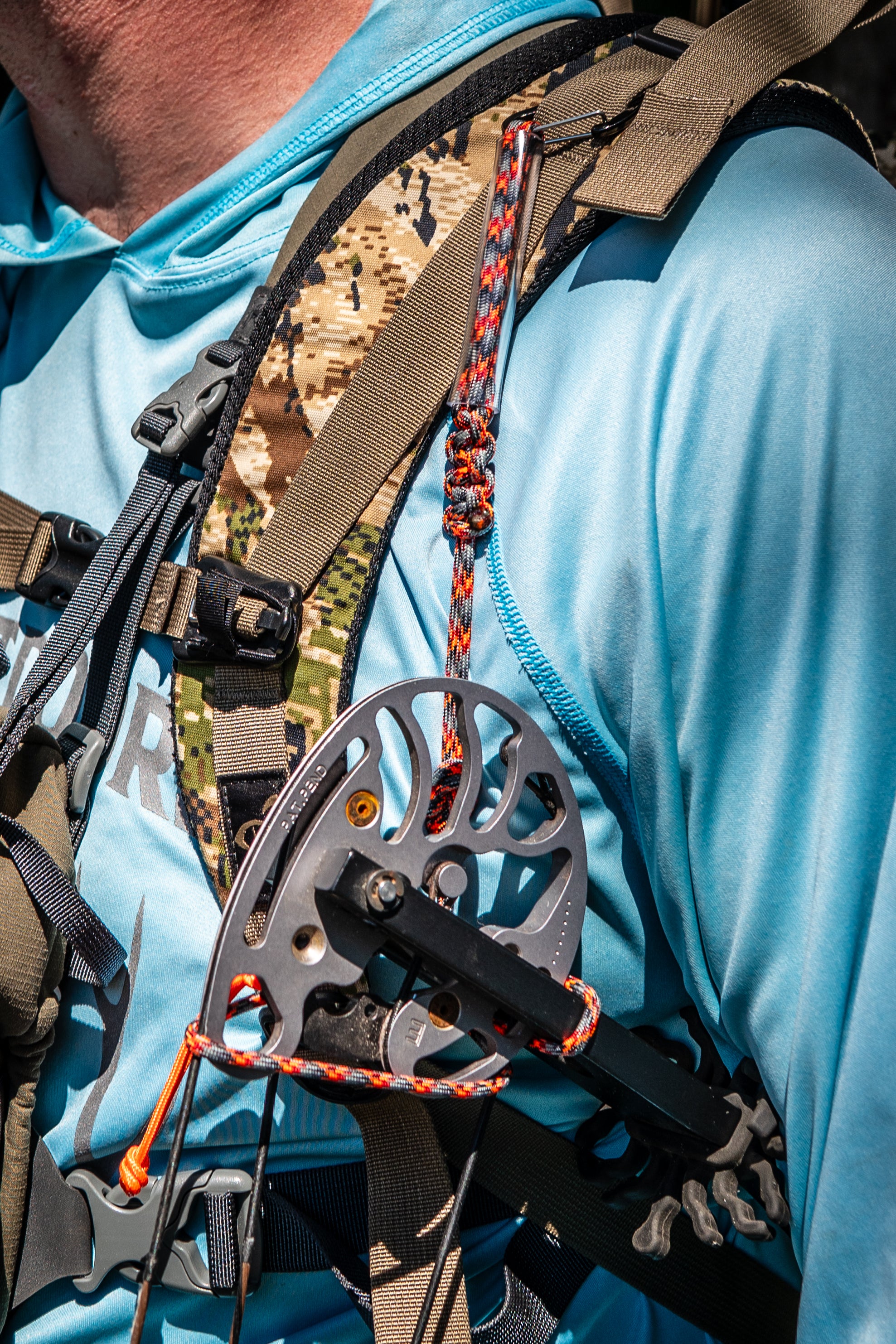
For comfort, pay attention to how the sling sits on your pack webbing or bino harness over an hour of walking. Hands-free carry matters most on long approaches, so note whether you feel pressure points or shifting. If fatigue builds on long carries, a plan for preventing arm fatigue during bow hunts lays out practical steps. You can compare quick release carry systems that actually work to see how other designs handle security and release.
Recheck the connection before every climb, not just at the trailhead.
The article breaks a compound bow sling test into three checks, each with a specific way to judge it.
| Check | What to do | Key question |
|---|---|---|
| Security | Climb, step over a log, kneel and stand | Does the bow stay seated without swinging? |
| Comfort | Walk for an hour on your pack webbing or harness | Do pressure points or shifting appear? |
| Connection | Recheck the attachment before each climb | Is it still secure before you start? |
Durability, Strength and Weight Capacity: What to Inspect
Durability is where many slings fail quietly. Inspect the cord, knots and attachment points before and after every hunt, and replace anything frayed or worn. Check for stretching, glossy or flattened spots where cord has rubbed against a hard edge, and loose knots that have started to creep.
Weight capacity deserves careful reading. A sling is designed to assist in carrying a compound bow, not to support a person's body weight, lift equipment or suspend gear for storage. Pushing a product beyond its intended use is the fastest way to find out where its limits are, and the result is rarely a good one.
When you inspect, look at the hand-tied construction closely. Consistent, tight knots and clean cord ends are signs of careful work. Loose or uneven knots are a reason to stop and retie before you rely on the sling.
Testing Hunting Gear Online: Reviews, Feedback and Red Flags
Online reviews are a form of field testing done by other people, and they are most useful when you read them the way you would read a test report. For a closer look at what hand-tied hunting gear reliability really looks like in practice, see this breakdown. The question is not whether a product has high ratings. The question is whether the people giving those ratings used the product in conditions similar to yours, for long enough to reveal wear.
Sort reviews by the details they include. A useful review states the bow weight or draw length, the pack or harness used, the terrain, and how many hunts or weeks the reviewer used the product. A review that says only that the sling is great after one afternoon tells you about first impressions, not durability. Give more weight to reviews that describe a problem that appeared after several uses.
Look for patterns across the critical reviews rather than the star average. If several reviewers independently describe the same failure point, such as a knot that loosens or a contact point that rubs, that is a specific finding you can check on your own product. A single one-star review with no detail is much weaker evidence than three three-star reviews that describe the same mechanism.
Treat small samples with caution. The LDH Outdoors listing for the Backpack Bow Sling shows a 4.5-star rating from 12 customer reviews. Twelve reviews is too few to estimate long-term reliability with any confidence, so use the listing as a starting point for your own testing rather than as a verdict. Read the lower-rated reviews in full and compare what they describe against the criteria in your own test log.
Watch for red flags that suggest a review is not reliable: identical wording across many products, reviews that appear in bursts with no dates, and listings that mention no limitations or intended-use boundaries. A credible product description states what the gear is designed for and what it is not designed to do, and its reviews usually reflect that same honesty about trade-offs.
Becoming a Hunting Product Tester: What Legitimate Programs Look Like
Hunters who want to test gear professionally often look for product tester roles. They explain how testers are selected, what the testing process involves, and whether any compensation or free product is offered.
Be cautious with programs that ask for payment to join, promise guaranteed earnings, or give no clear details about the products or the test process. A reputable program will want honest, detailed feedback, including negative findings, and will not require you to post only praise.
Before applying, document your field experience. Describe the terrain you hunt, the species you pursue and the gear you already use. Clear, specific experience makes a stronger case than general enthusiasm, and it helps the company match you with the right products.
Booking Your Backpack Bow Sling Test Run
If you want to evaluate a hand-tied sling yourself, start with a short test run before your season. Attach the sling to your existing pack or bino harness, load your bow, and run through the full routine: climb, step, kneel, stand and release. Repeat it on two or three separate days and log your observations.
When you are ready to try it, you can buy the Backpack Bow Sling directly from LDH Outdoors for $29.95. Inspect it before every use, follow the safety guidance included with the product, and keep your own notes so you can judge its performance on your terms.
Frequently Asked Questions
How do you test hunting gear before a hunt?
Start at home by inspecting every stitch, buckle, and attachment point, then load the gear with weight similar to your real pack. Walk the same grade you expect to hunt, including steep ascents, sidehill traverses, and brushy stretches. Note any slipping, rubbing, or loosening, and repeat the test over several outings. Log what fails and what holds up, because one short walk rarely reveals durability problems. Finish with a check of how quickly you can release or reattach the gear with cold or gloved hands.
What should you look for when testing hunting gear?
Focus on four things: security under movement, comfort over distance, durability of materials and stitching, and how easily the gear works in real conditions. For a compound bow sling, check that the bow stays put on steep terrain, that the attachment doesn't interfere with the cams, cables, or string, and that the cord shows no fraying after repeated use. Record results from each outing so you can compare performance over time instead of relying on first impressions.
How do you evaluate the durability of hunting equipment?
Look at materials, construction, and wear points. Inspect stitching under tension, buckles and connectors for cracks, and any cord or strap that rubs against a backpack or bow. Repeat the same carry, release, and reattach cycle many times to see whether anything loosens or weakens. Remember that no carrying system can guarantee equipment stays secure in every condition, so inspect gear before each use and replace anything showing excessive wear or damage.
Can I get paid to test hunting gear?
Be cautious of any program that charges fees or promises guaranteed income. Before applying to any tester program, review the company's product information and make sure you can meet the time commitment and reporting requirements.


