

How to Keep Bow Accessories Quiet While Walking
Keeping your bow accessories quiet on the walk in is easier than you think. Learn which string silencers and limb dampeners are worth buying.

In this article
Quick Summary
To keep bow accessories quiet while walking, check each part for play by rocking, tapping, and twisting it, then tighten loose bolts and pad contact points. Most walking noise comes from loose sight brackets, rattling quivers, and stabilizers that knock against the riser.
- Test each accessory by rocking the bow about 30 degrees, tapping the part, and twisting it gently.
- Mark any bolt or joint that shows play with painter's tape, then snug it with the correct driver.
- Use thin rubber or felt strips or foam sleeves on contact points, choosing removable padding only.
- Carry the bow with a riser grip or a sling that holds it tight, and walk with shorter steps on uneven ground.
- Check that jacket cuffs and pack straps do not contact the sight or quiver, and walk your full setup before hunting.
Table of Contents
- Why Your Bow Rattles While You Walk (and Why It Matters)
- Separating Walking Noise From Shot Noise
- A Systematic Accessory-by-Accessory Rattle Check
- Quieting Your Sight, Rest, Quiver and Stabilizer
- Installing String Silencers and a Bow String Stop
- Limb Dampeners and Safe Ways to Pad Contact Points
- Carrying Your Bow Quietly: Your Next Step Before the Hunt
- Frequently Asked Questions
Why Your Bow Rattles While You Walk (and Why It Matters)
Few things ruin a stalk faster than a rattling bow. You take one careful step, and a loose sight pin or a clicking quiver knocks against your riser. Game hears it, and the hunt is over before the shot.
Most hunters blame their bow or their arrows first. In practice, the noise often comes from small accessories that have worked loose. A sight bracket, an arrow rest, a quiver mount, or a stabilizer can each make a sound that carries surprisingly far in quiet woods.
Common sources of walking noise include:
- Loose sight brackets and pin housings
- Quivers that rattle against the bow or the hunter's pack
- Stabilizers that vibrate or knock against the riser
- Arrow rests and drop-away mounts that work loose
- Cables and strings that slap during movement
This guide walks through how to find each noise source, separate walking noise from shot noise, and keep your gear quiet all the way to the stand.
Separating Walking Noise From Shot Noise
Walking noise and shot noise are different problems, and they need different fixes. Walking noise happens when accessories knock together while you move. Shot noise happens when the bow fires and vibration travels through the riser and limbs.
To tell them apart, handle the bow without drawing it. Gently tap or shake each accessory and listen. If you hear a rattle, the problem is walking noise. If the sound only appears after a shot, focus on dampeners and tuning instead.
Quick test to try at home:
- Hold the bow by the riser and walk slowly across a carpeted room.
- Listen for clicks, buzzes, or rattles.
- Stop and gently rock the bow side to side.
- Note any accessory that moves or makes contact.
Solving walking noise first makes sense because it affects every step you take. Shot noise matters too, but you can only fix it once the bow is quiet during movement.
A Systematic Accessory-by-Accessory Rattle Check
Set up a quiet test space. Work in a carpeted room or on a rubber mat with the door closed.
Test each accessory with three motions. For every part, do all three before deciding it is quiet:
- Rock: hold the riser in one hand and rock the bow slowly side to side about 30 degrees, the way it swings on a sling.
- Tap: tap the accessory body lightly with one finger while the bow is still. A loose mount will buzz or click.
- Twist: apply gentle twisting pressure to the accessory in the direction it would move if it shifted. Do not force it; you are listening for play, not trying to loosen it.
Work through the checklist in this order:
- Sight: Rock and tap the bracket and pin housing. Grab the sight housing and try to twist it. Any movement at the mount means the bracket bolts need a quarter turn. Also check the fiber-optic guard and any rheostat or light attached to the housing, since those small parts buzz independently.
- Arrow rest: With the bow at rest, tap the rest arm and the mounting block. Then twist the block gently. A drop-away rest that moves on its mount will click every time the bow rocks. Confirm the cord or cable clamp is tight and not slapping the cable.
- Quiver: This is the most common walking-noise culprit. Mount the quiver as you would in the field, then rock the bow and listen. Tap each arrow shaft and the quiver hood. Grab the quiver body and try to twist it on its mount. Then check the individual arrow grippers: a gripper that has stretched will let arrows knock together. Rubber or foam inserts in the hood and grippers stop shafts from clicking.
- Stabilizer: Twist the rod gently at the riser connection and tap along its length. A stabilizer with a quick-disconnect can rattle at the joint. Check that the rod does not contact the riser, cables, or quiver when the bow rocks. Front and rear bars should be tested separately because they load the mount differently.
- Cables and strings: Run a finger along each cable and look for worn spots or frayed servings where cables rub. Rock the bow and watch for cables slapping the cable guard, the quiver, or each other. A cable that contacts the guard under movement will tick with every step.
- Peep sight and D-loop: Twist the peep gently and confirm it does not slide on the string. Check that the D-loop knots are tight and that the loop does not slap the string or rest when the bow rocks.
- Riser accessories: Lights, levels, wrist slings, bowfishing mounts, and any extra brackets each get the rock, tap, and twist test. A loose wrist sling is a surprisingly loud offender because it swings freely.
Mark anything that moves. Put a small piece of painter's tape next to any bolt or joint that shows play, then tighten it with the correct driver.
Watch out: Loosening or removing one accessory to chase a rattle can shift your sight or rest alignment.
Re-test after a few days of shooting. Vibration loosens hardware over time, so run the same three motions again after your next practice session.
Each accessory gets three quick tests, and the checklist below shows which part to inspect and what to look for.
| Accessory | What to check | Common sign of noise |
|---|---|---|
| Sight | Bracket bolts and pin housing | Movement when twisted |
| Arrow rest | Mounting block and rest arm | Click when bow rocks |
| Quiver | Mount, hood, and arrow grippers | Arrows knock together |
| Stabilizer | Rod connection and contact points | Rattle at the joint |
| Cables and strings | Cable guard and contact with quiver | Tick with each step |
| Peep sight and D-loop | Peep slide and knot tightness | Loop slaps the string |
| Riser accessories | Wrist sling, lights, brackets | Loose sling swings freely |
Quieting Your Sight, Rest, Quiver and Stabilizer
Each of these accessories has its own quick fixes.
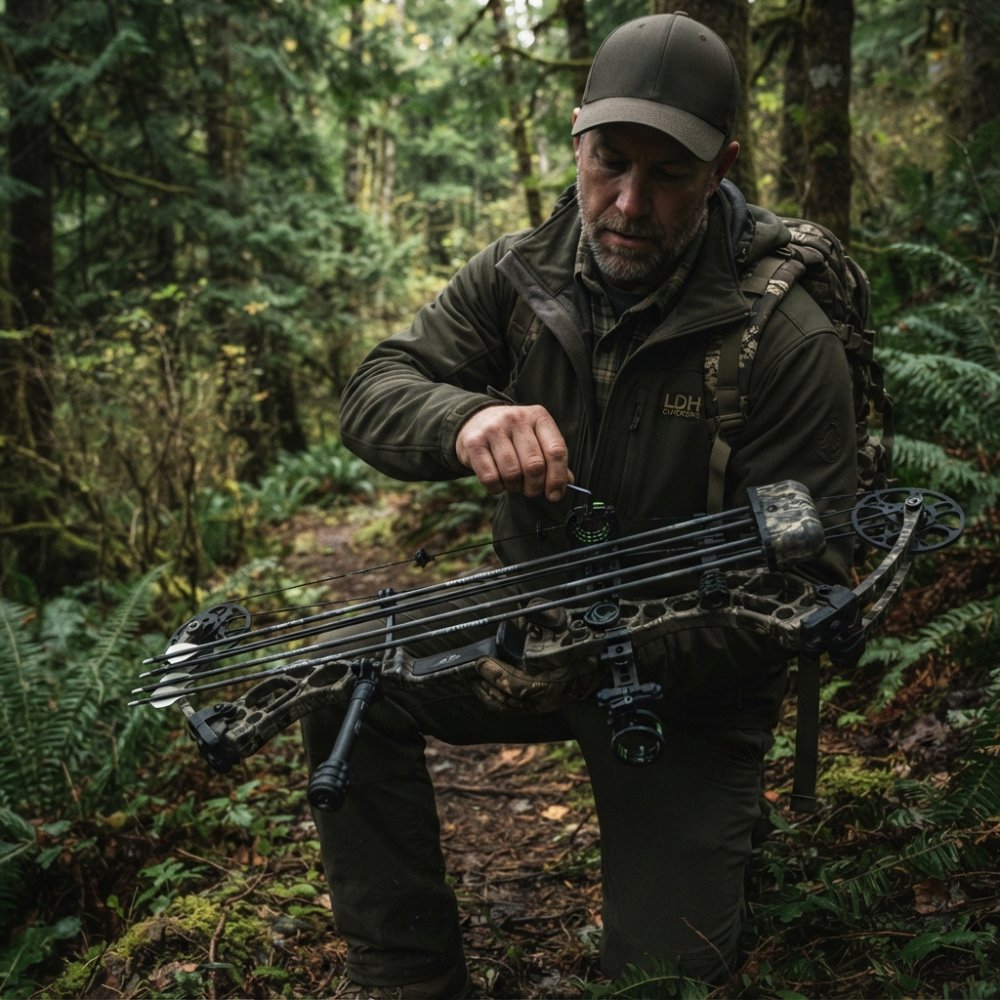
Sight: Use a drop of thread locker on sight bolts if your bow manufacturer allows it.
Arrow rest: Most rattles here come from a loose mount or a rest that moves on its shelf.
Quiver: A quiver that clinks against the bow is one of the most common walking noises. For more on protecting the cams, read how to prevent bow cam damage in seven steps.
Stabilizer: Tighten the stabilizer connection and make sure the rod does not touch the riser or other accessories. Some stabilizers use rubberized bushings that quiet contact.
Common mistake: Adding too much padding can change how the bow balances or how your arrows sit. Add small amounts, test, and adjust.
Installing String Silencers and a Bow String Stop
String silencers and a bow string stop reduce noise during the shot and help keep the string from slapping during movement. Installing them correctly is simple.
String silencers:
- Attach the silencer to the bowstring, usually at the center serving.
- Position it so it does not touch the arrow or the arrow rest.
- Check that it stays in place when you draw and release.
Bow string stop:
- Place the stop on the bowstring near the cam or on the limb, depending on the design.
- Confirm it limits string movement without changing your draw length.
- Test a few dry draws to make sure nothing binds.
Installing these correctly matters because a loose silencer can rattle on its own. Always recheck the serving and attachment points after your first few shooting sessions.
Limb Dampeners and Safe Ways to Pad Contact Points
Limb dampeners reduce vibration that travels into the riser. They are most useful for shot noise, but they can also cut down on small vibrations while you walk.
Choosing limb dampeners: Pick dampeners sized for your bow's limbs. Attach them according to the manufacturer's directions, and keep them clear of the cams and strings.
Safe, reversible padding ideas:
- Thin rubber or felt strips on contact points (test first, since some adhesives leave residue)
- Foam sleeves on the quiver body
- Silicone bumpers on the riser where accessories touch
- Electrical tape as a temporary fix (remove it before shooting if it interferes with the grip or sight)
Avoid glue or permanent adhesives on any part of the bow. Padding should always be removable, and you should never cover anything that affects safe operation, such as the string, cables, or cams.
Carrying Your Bow Quietly: Your Next Step Before the Hunt
Quieting your accessories is only part of the job.
Choose a carry position that locks the bow down. There are three common field carries, and each has a noise trade-off:
- Riser grip carry: hold the bow by the riser with the limbs angled away from your body. This is the quietest option because your hand absorbs swing, but it ties up one hand and gets tiring on long hikes.
- Sling carry: a bow sling over one shoulder keeps the hands free but lets the bow swing. A sling that holds the bow tight against your back or side cuts the swing dramatically. Test the sling empty and loaded, because a bow that rides well unloaded can shift once a quiver is full.
- Pack-mounted carry: attaching the bow to your pack keeps it stable on steep ground, but the attachment points themselves can creak. Check the straps and buckles on the pack, not just the bow.
Control the swing. Whatever carry you choose, the goal is to stop the bow from building momentum.
Mind your clothing and pack straps. Jacket cuffs, glove wrists, and pack straps are common noise sources around bow accessories.
Use a sling or carry system that holds the bow steady. A hands-free carry system that holds the bow close to your body keeps it from swinging as you move. Compare backcountry bow carry alternatives to see other proven options.
Watch out: A carry system that holds the bow too loosely can let the cams or stabilizer knock against your pack frame.
Before every hunt, run through your rattle check, confirm each accessory is tight, and make sure your carry system is secure.
Frequently Asked Questions
Do bow string silencers reduce noise while walking?
Bow string silencers mainly reduce the sound and vibration of the string and cables when the bow is shot. They do little for walking noise, which usually comes from accessories that rattle against the riser, limbs or each other as you move. To quiet a bow while walking, check each accessory for play, tighten the hardware, and add padding or a bow string stop where metal contacts metal. Use silencers for shot noise and the checklist for carry noise.
How do you keep bow accessories from rattling while walking?
Start by carrying the bow with everything mounted and shaking it gently to find the source of each rattle. Check the sight, arrow rest, quiver, stabilizer and any clamps or brackets for movement. Tighten each fastener, add thread-locking compound where the manufacturer allows it, and wrap loose clips with soft tape or foam. Re-check after the first few miles, since vibration can loosen hardware over time.
How do you keep a bow quiet when carrying it on your back?
Carrying the bow on a sling or harness helps keep it from swinging against your pack or body. An LDH Outdoors Backpack Bow Sling ($29.95) attaches to most backpacks and most compound bows, and is designed to carry your bow hands-free. Before every hike, inspect the straps, buckles and attachment points, and confirm the bow is secure before moving over rough ground.
Can limb dampeners stop a bow from rattling?
Limb dampeners reduce vibration and the buzz that travels through the limbs after a shot, which is their main job. They are less effective against rattling that comes from loose accessories while walking. Use dampeners to quiet the bow when it is fired, and tighten or pad accessories to stop carry noise. Confirm any dampener is compatible with your bow before installing it.


