

Quick Release Bow Carry Systems: What Actually Works
Compare quick release bow carry systems for backcountry hunting. Learn what matters: retention, comfort, attachment speed, and field reliability.

In this article
Table of Contents
- What Makes a Quick Release Bow Carry System Worth Your Money
- How to Attach a Bow to a Backpack: The Core Mechanics
- Backpack Bow Holder Options: What Separates the Best from the Rest
- Quick Release Bow Sling Design: Speed, Security, and Simplicity
- Bow Sling Reviews: Real-World Performance in Steep Terrain
- Common Mistakes That Compromise Bow Security and Field Reliability
- Conclusion: Choosing the Right Carry System for Your Hunt
- Frequently Asked Questions
Last Updated: October 21, 2026
What Makes a Quick Release Bow Carry System Worth Your Money
Hiking 10 miles into backcountry terrain with a $1,200 compound bow, the last thing you want is fumbling with straps.
At LDH Outdoors, we've spent years refining how hunters carry their bows. Our Backpack Bow Sling is the lightest, simplest approach on the market without compromising security or reliability.

The difference between a system that works and one that fails comes down to three things: how it attaches, how it holds tension, and how predictably it releases.
How to Attach a Bow to a Backpack: The Core Mechanics
Attaching a bow to a backpack sounds straightforward until you're doing it with cold hands at 8,000 feet. Attachment points, fit variables, and safety checks are where most problems start.
Start With Your Pack's Anchor Points
Your backpack likely has webbing loops, daisy chains, or MOLLE-style attachment points designed to handle load. Use them rather than adding hardware that compromises your pack's waterproofing or warranty. A proper quick release bow sling anchors to existing webbing: no drilling, no extra buckles.
Before you buy, confirm your pack has at least one solid webbing loop on the side or rear panel where the bow will ride. Most modern hunting packs do; ultralight hiking packs sometimes don't. Bino harnesses with webbing also work.
The Attachment Sequence
The process should take under 30 seconds once you understand the mechanics:
- Position the sling under one bow limb, just inside the cam.
- Pull the sling over the cam and let the bow's weight cinch it tight.
- Route the release cord back toward your strong-side hand so you can reach it while walking.
- Give the bow a firm tug to confirm the sling is seated and not creeping.
To deploy, lift the bow slightly to release tension, pull the cord, and the sling falls free.
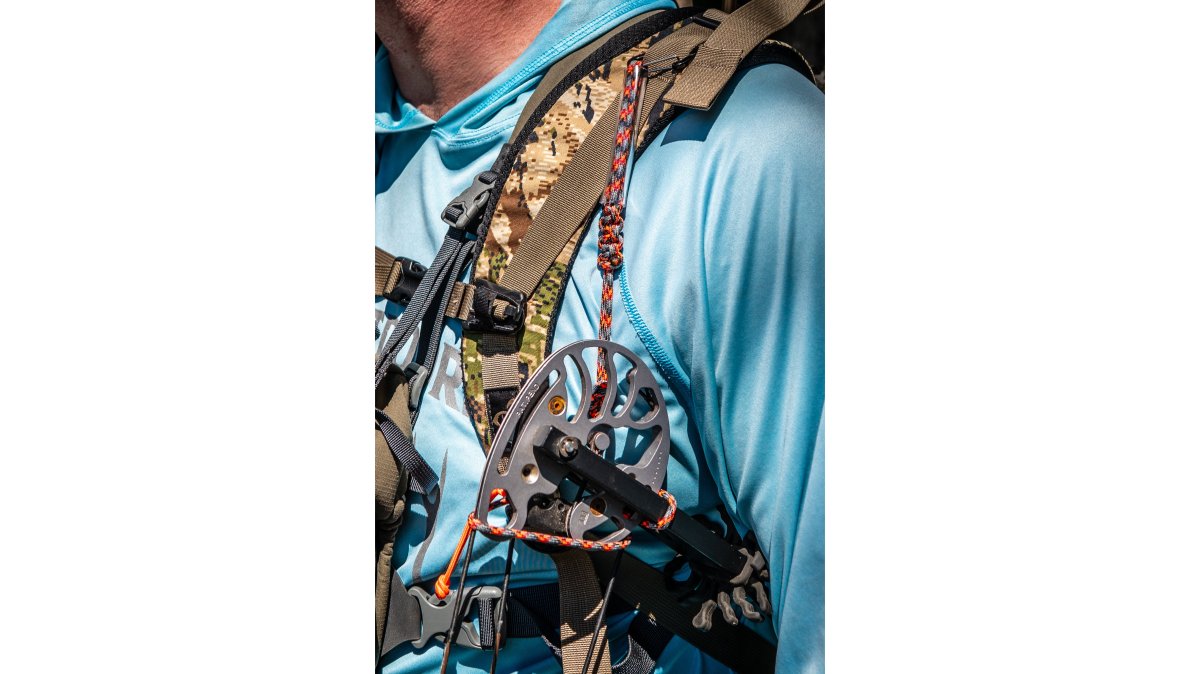
Compatibility: What Fits and What Doesn't
Fit problems are the most common frustration with carry systems. Check these variables:
- Bow style. Compound bows with parallel or past-parallel limbs are the easiest fit. Long-axle-to-axle bows and traditional recurves may need a different anchor position or a longer sling.
- Cam size and limb thickness. Oversized cams and thick split limbs can crowd a sling that's sized for standard geometry. Confirm the sling seats fully over the cam without pinching.
- Accessories. Stabilizers, quivers, and string stops change the bow's profile and can interfere with how it sits against the pack. Test with your full hunting setup, not a bare bow.
- Attachment points. Webbing loops, daisy chains, and MOLLE panels all work; smooth fabric panels without loops do not. Measure the loop spacing before ordering.
Safety and Accidental-Release Checks
A quick release system is only as safe as its weakest check. Build these into your routine:
- Seat check. After attaching, tug the bow firmly in multiple directions. If it shifts, reseat it before moving.
- Cord routing. Keep the release cord clear of brush, pack straps, and your harness. A cord that can snag is a cord that can trip.
- Pre-draw confirmation. Before you commit to a stalk, confirm the sling is seated and the cord is where your hand expects it.
- Post-fall inspection. After a slip or a hard sit, recheck the attachment. Impacts can unseat a sling even when it looked fine.
Backpack Bow Holder Options: What Separates the Best from the Rest
Not all bow carry systems are created equal. Some prioritize speed, others security; the best ones don't force you to choose.
Many hunters default to what they see at the shop or what their buddies use, which misses the actual trade-offs.
The LDH Outdoors Backpack Bow Sling keeps it simple. Hand-tied in Oregon, it weighs almost nothing and attaches to existing pack webbing.
When evaluating options, ask: How many times will I adjust this in a day? How many things can break? Can I fix it in the field? The answers should be: rarely, almost nothing, and yes.
Quick Release Bow Sling Design: Speed, Security, and Simplicity
A quick release bow sling's design determines performance across three dimensions: deploy speed, security during movement, and simplicity of use.
Speed matters because hesitation costs opportunities. When you spot a bull at 200 yards, you need your bow ready in seconds.
Security matters because your bow is expensive and the terrain is unforgiving.
Simplicity matters because complexity fails in the field.
The LDH Outdoors design prioritizes all three. Hand-tied construction means no plastic to crack or metal to bend.
This simplicity comes from design discipline, not cutting corners.
Bow Sling Reviews: Real-World Performance in Steep Terrain
Most bow sling "reviews" online are product pages with a star rating bolted on, which doesn't tell you whether a system holds up on a five-day backcountry hunt. Here's the evaluation framework we use, plus what shows up when a quick release carry system is pushed in steep country.
How We Evaluate a Carry System
We score every system on six criteria, each pass/fail or 1-5, so results are comparable across products:
- Retention under load. Load the bow, then walk, jog, and sidehill for a set distance. Does the bow shift, rotate, or loosen? A system that needs re-tightening mid-hike fails.
- Release speed. Time the deploy sequence from a normal walking carry to bow-in-hand, cold hands, gloves on. Anything that requires two hands or a visual check costs seconds you may not have.
- Comfort over distance. Note pressure points at the shoulder, sternum, and hip after several miles with a loaded pack. Weight distribution matters more than total weight.
- Noise. Listen for hardware rattle, strap slap, and limb contact while moving through brush. Quiet is a hard requirement, not a nice-to-have.
- Durability. Inspect wear points after a full season: strap edges, knot or stitch junctions, and any contact with cam or limb edges.
- Accidental-release resistance. Deliberately snag the release cord on brush and pack straps to see whether the system can be tripped unintentionally.
What the Field Actually Reveals
A few patterns hold across most systems:
- Minimalist, hand-tied slings tend to win on noise and weight and lose nothing on retention when attached correctly, because the bow's own weight maintains tension. Their weak point is the attachment itself: if the sling isn't seated under the limb and over the cam properly, it can creep.
- Hardware-based systems with buckles and clips feel more adjustable in the store but introduce rattle and failure points. Plastic clips are the most common field failure we see reported.
- Weight distribution is the sleeper issue. A sling that concentrates load on one webbing loop makes the pack feel lopsided by mile three, even if the sling itself weighs almost nothing.
- Release ergonomics separate good systems from great ones. The cord or tab needs to sit where your hand naturally falls while walking, not behind your shoulder or under a pack strap.
Field-Use Scenarios Compared
Performance isn't uniform across terrain, so evaluate a system against how you actually hunt:
- Hiking and approach: retention and comfort dominate. Check for shift after a few miles and pressure points under load.
- Climbing and scrambling: the bow must stay tight against the pack and clear of your hands. Any swing or pendulum motion is a fail.
- Tree stand sits: the release needs to work while seated and tethered. Practice deploying from a seated position with a harness on.
- Brush and deadfall: noise and snag resistance matter most. Route the release cord so brush can't catch it.
The Honest Trade-offs
No system wins every category. A hand-tied sling like the LDH Outdoors Backpack Bow Sling ($29.95) is quiet, light, and simple, and releases with a single cord pull. The trade-off: it depends on correct attachment and offers no micro-adjustment, so it suits hunters who set it once and leave it. Hardware-heavy systems offer more tuning but add weight, noise, and parts that can break.
Common Mistakes That Compromise Bow Security and Field Reliability
Most hunters make the same mistakes with bow carry systems. Here's how to avoid them.
The first mistake is over-engineering.
The second mistake is ignoring compatibility. A sling designed for one bow type frustrates you when it doesn't fit your new bow.
The third mistake is neglecting inspection.
The fourth mistake is not practicing. Use a new sling once at home, then deploy it under real pressure, and your hands won't remember the sequence.
The fifth mistake is assuming all quick release systems are the same.
Conclusion: Choosing the Right Carry System for Your Hunt
Choosing a quick release bow carry system comes down to matching your needs to your gear. Hunt steep terrain and value simplicity? A hand-tied sling that uses existing backpack webbing makes sense. Want the lightest option? Minimalist design wins.
The LDH Outdoors Backpack Bow Sling delivers on all three fronts.
The real test of any gear is whether it disappears into your workflow. That's what we've built. Shop now and experience the difference of gear designed by hunters, for hunters.
Frequently Asked Questions
How secure is a quick-release bow sling while hiking steep terrain?
A properly installed quick release bow sling secures your bow through weight distribution and tension. The bow's weight holds the sling tight against the attachment point. When hiking steep or uneven ground, the key is verifying attachment before each move and maintaining awareness of your bow's position. Hand-tied slings like the LDH Outdoors Backpack Bow Sling ($29.95) rely on consistent tension and quality materials to keep your bow stable during scrambling or climbing.
Can a quick release bow sling fit different compound bows?
Most quick release bow slings are designed to work with standard compound bow cams and limb dimensions, though fit varies by bow model and cam size. The LDH Outdoors Backpack Bow Sling attaches to most compound bows and most backpack or bino-harness webbing. Before purchasing, verify your bow's cam diameter and limb configuration match the sling's design. Compatibility is highest with mid-range to full-size hunting bows; smaller or specialty bows may require adjustment or a custom solution.
What should you look for when comparing bow carry systems?
Prioritize retention security, release speed, attachment compatibility, comfort during long hikes, and material durability. Test how quickly you can deploy your bow under pressure, slow release defeats the purpose of a carry system. Check strap width and padding for weight distribution over your shoulders or pack. Verify the system works with your existing backpack or bino-harness webbing.
Are bow slings worth it for backcountry hunting?
Yes, if you hike long distances and need hands-free bow carrying. A quality quick release bow sling eliminates the fatigue of hand-carrying your bow for miles, keeps both hands free for scrambling or glassing, and allows rapid deployment when you spot game. The investment pays off in reduced shoulder strain, faster reaction time, and the ability to glass and stalk without setting your bow down repeatedly. Lightweight options like hand-tied slings minimize pack weight while maximizing functionality.
A quick release bow carry system is one of those purchases that pays dividends across every hunt. The right choice saves weight, reduces fatigue, and gives you one fewer thing to worry about when it matters. LDH Outdoors built the Backpack Bow Sling to be that choice, lightweight, hand-tied, compatible with most gear, and designed for reliability in steep terrain. Get started with the LDH Outdoors Backpack Bow Sling and focus on what actually matters: the hunt.


