

9 Points to Compare Jakt Gear and Hunter Spec Slings
A bow sling comparison of Jakt Gear and Hunter Spec across nine points, from carry comfort to steep-terrain security. Find out which one fits your hunts.

In this article
Last Updated: November 2, 2026
Quick Summary
A bow sling comparison between Jakt Gear and Hunter Spec comes down to attachment and compatibility, since their designs diverge most in how they mount to your pack and bow. Jakt Gear integrates with pack webbing, while Hunter Spec uses its own mounting and tensioning hardware. Check each brand's current product page before you buy.
- Jakt Gear integrates with pack webbing; Hunter Spec uses its own mounting and tensioning hardware.
- Measure your pack's webbing width and attachment points before comparing brands.
- Confirm the retention element is fully engaged before any steep descent.
- Compare total cost of ownership, not sticker price, including required hardware and pack compatibility.
Table of Contents
- Why Carry Method Matters More Than Most Hunters Expect
- How to Carry a Compound Bow While Hiking Without Losing Your Hands
- Jakt Gear vs Hunter Spec: How the Two Bow Slings Are Built
- Choosing a Bow Sling for Hunting Backpack Setups
- Mountain Hunting Backpack Setup: Where the Sling Fits
- Price, Value and Return Policy: What to Check Before You Buy
- Choosing Your Sling for the Next Hunt and Trying LDH Outdoors
- Frequently Asked Questions
Why Carry Method Matters More Than Most Hunters Expect
A bow that sits in your hand for three miles of hiking is a bow that wears you out before the hunt starts. Most hunters underestimate how much a carry system affects stamina, balance and shooting readiness. We think the carry method is one of the most overlooked decisions in backcountry gear.
If you are weighing a bow sling comparison between Jakt Gear and Hunter Spec, you are really comparing two philosophies: how a sling should attach, how it should hold the bow, and how much it should interfere with your pack. Those choices shape how you move on steep ground, how quickly you can get the bow into your hands, and how often you fight with straps.
This comparison covers the points that matter in the field, based on the design and product information we can verify. We have no independent testing data for these two products, so we avoid claims we cannot support. Where the answer depends on your setup, we say so.
How to Carry a Compound Bow While Hiking Without Losing Your Hands
Carrying a compound bow while hiking comes down to three things: keeping the bow close to your body, keeping your hands free, and keeping the bow secure on uneven ground. A sling that does two of these well is useful. One that does all three is worth a closer look.
A common mistake is hanging the bow off one shoulder with a loose strap. The bow swings on every step, and the cams catch brush. A tighter attachment to the pack keeps the bow stable and lets you use both hands on trekking poles or while you glass.
Watch out: a bow that is not secured before a steep descent can slip out of its carry point. Check the attachment before you start downhill, not after.
Jakt Gear vs Hunter Spec: How the Two Bow Slings Are Built
The two slings are designed to carry a bow hands-free, and they approach attachment differently. Check each brand's product page for how its sling is built and attached before you decide which approach suits your pack. You can also review the Backpack Bow Sling product page to check its fit and details directly.
Because manufacturer specifications change and we do not have independent lab data for either product, treat the points below as the questions to verify on each brand's current product page before you buy.
Attachment and Compatibility With Your Pack
This is where the two designs diverge most, and where most hunters should start.
- Jakt Gear (pack-attachment approach): The sling is designed to integrate with pack webbing and a bow-holding element. The practical questions are: Does it require a specific webbing width or loop configuration on your pack? Does it need a dedicated mounting point, or will it clamp to standard webbing? Does it fit day packs and multi-day packs, or is it sized for one class of pack?
- Hunter Spec (mounting and tensioning approach): The sling uses its own mounting and tensioning hardware. The practical questions are: Does the mount attach to the pack, the bow, or both? Does the tensioning element need to be adjusted for different bow weights and riser shapes? Does the mounting hardware interfere with a quiver, stabilizer, or sight?
If you already run a chest harness or hip-belt system, check how each sling interacts with it. A bow that bounces against your torso or catches on pack straps will annoy you within the first mile, and that is a fit problem, not a durability problem.
Security on Steep and Brushy Ground
Steep, brushy terrain tests a sling harder than flat trail. The bow needs to stay put when you scramble uphill, duck under branches, or step sideways across a slope.
A useful way to compare any two designs is to ask how each one resists three specific failure modes:
- Vertical slip, does the retention element tighten under load, or does it depend on a fixed strap tension that loosens as the bow shifts?
- Lateral swing, does the design constrain the bow against the pack on both sides, or only at one point?
- Brush snag, do the cams and limbs sit inside the pack's silhouette, or do they project where branches can catch them?
We have no verified field data on how either product performs under those conditions. If steep ground is your main hunting environment, test any sling on a similar slope before your hunt, and check the attachment before you start downhill, not after.
What to Verify on Each Manufacturer's Page
Use this short list as a side-by-side checklist so you can compare the two brands on the same terms rather than on marketing language.
- Materials: webbing type and width, hardware material, and whether any load-bearing component is plastic or metal.
- Dimensions: overall length, strap adjustment range, and the maximum bow weight or riser size the design is rated for.
- Attachment method: pack webbing, dedicated mount, or bow-mounted; and whether hardware is included or sold separately.
If a manufacturer does not publish one of these, that absence is itself useful information when you compare value in the next section.
The two slings differ most in attachment and compatibility, so here is the checklist to verify on each brand's product page before you decide.
| Check | What to verify | Why it matters |
|---|---|---|
| Attachment | Pack webbing, dedicated mount, or bow-mounted | Decides whether your current pack works |
| Retention on steep ground | Tightens under load, constrains both sides, keeps cams inside silhouette | Stops slip, swing and brush snag |
| Materials | Webbing type and width, hardware material | Shows load-bearing strength |
| Dimensions | Length, strap adjustment range, rated bow weight | Confirms fit to your bow |
| Included parts | Hardware, retention straps, tools | Shows the true cost to set up |
| Bow compatibility | Compound vs traditional, riser shape, quiver or stabilizer removal | Prevents fit surprises |
Choosing a Bow Sling for Hunting Backpack Setups
Start with your pack and your terrain, because the right bow sling comparison begins with how you actually hunt.
Consider how quickly you need to get the bow off your back. If you expect to shoot from a sitting or kneeling position after a long stalk, choose a sling with a simple release.
Check the Backpack Bow Sling product page for its specifications and fit details before you decide.
Mountain Hunting Backpack Setup: Where the Sling Fits
In a mountain setup, the sling sits between your pack and the bow, and it has to handle both load and movement. The best position keeps the bow's center of gravity close to your back so it does not pull you off balance on switchbacks.
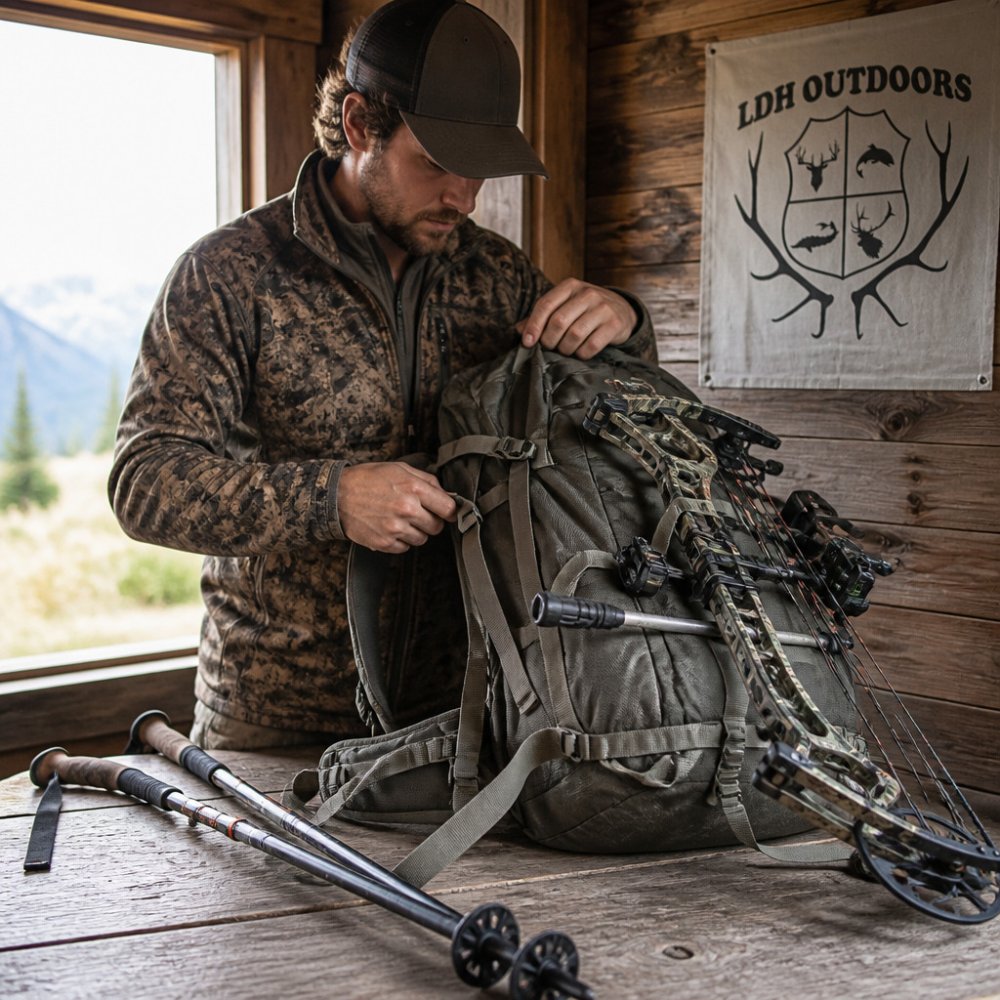
A hunter moving uphill with a compound bow secured hands-free to a day pack and trekking poles in hand is the kind of setup these slings are meant to support. For a deeper look at lightweight options for long hikes, read our guide to lightweight bow slings for backcountry hunting.
Hunters working steep ground often pair their sling with other gear built for those conditions. Our guide to gear for steep terrain hunting covers related choices.
Price, Value and Return Policy: What to Check Before You Buy
Most comparison articles stop at the sticker price. That is the wrong number. The number that matters is cost of ownership: the sling plus the hardware it requires plus the pack it forces you to buy plus the replacement parts you will need over a few seasons. This section gives you a framework for calculating that number for either brand, because published prices change and we will not quote a figure we cannot verify today.
Build a True Cost of Ownership
Add these line items for each brand before you decide:
- Sling price, the current retail listing on the manufacturer's site.
- Required hardware, mounting hardware, retention straps, and any tools. Confirm whether these are included or sold separately; a sling that requires a separate mount is not the same value as one that ships complete.
- Pack compatibility cost, if the sling only works with a specific pack or webbing configuration, and you do not own that pack, add the pack cost. A sling that requires a new pack costs far more than its listed price.
- Replacement parts, straps, buckles, and retention elements wear first. Check whether the manufacturer sells replacements individually or only as a kit.
- Return shipping, if you pay return shipping to test fit, that is part of the cost of finding the right sling.
Warranty and Long-Term Support
Warranty coverage is where the two brands are most likely to differ, and it is the item shoppers check last. Before you buy, confirm four things on each manufacturer's site:
- Warranty length and what it covers, materials and workmanship versus normal wear.
- Replacement parts availability, whether individual straps and hardware can be ordered.
- Customer service channel, email, phone, or web form, and the stated response window.
A longer warranty on a sling with no replacement parts is less useful than a shorter warranty backed by individual part sales. Read both policies side by side rather than in isolation.
Return Policy: Test Fit on Your Own Pack
Before you buy from any brand, check its return policy on the manufacturer's website, including the return window, who pays return shipping, and how long a refund takes. Testing fit on your own pack and terrain is the most useful check for a carry system.
Use-Case Recommendations
Rather than declare a universal winner, match the design to your hunt:
- Long-distance, lightweight backpacking: prioritize low weight and a simple attachment that does not add hardware to your pack.
- Steep, brushy terrain: prioritize retention that constrains the bow on both sides and keeps cams inside the pack silhouette.
- Heavy loads and multi-day packs: prioritize attachment that integrates with existing pack webbing rather than requiring a dedicated mount.
Write down your top two non-negotiables before you compare prices. A sling that wins on cost but fails your non-negotiables is not a value, and a sling that costs more but fits your pack and terrain is the cheaper option over several seasons.
Choosing Your Sling for the Next Hunt and Trying LDH Outdoors
Your next sling should match your pack, your terrain and your shooting routine. Make a short list of your non-negotiables: attachment type, weight, steep-ground security and release speed.
At LDH Outdoors, we make the Backpack Bow Sling, a hand-tied sling designed by hunters for hunters in Gresham, Oregon. It attaches easily to your existing gear so your hands stay free.
Frequently Asked Questions
What is the difference between Jakt Gear and Hunter Spec bow slings?
Both are designed to carry a compound bow hands-free, but they differ in construction, attachment method and how they handle load on steep ground. Each brand takes its own approach to design and attachment. Compare the attachment points, weight and how each sits against your pack before deciding. Check current specifications and pricing directly with each manufacturer, since product details change over time.
Which bow sling is easier to attach to a hunting backpack?
Ease of attachment depends on your pack's straps, daisy chains and webbing loops. Slings that clip or tie to existing attachment points usually install faster than designs requiring added hardware. Test the setup with your loaded pack at home before a hunt, and confirm that the sling does not interfere with your shooting arm or pack lid.
Can a bow sling keep a compound bow secure while hiking?
A properly attached bow sling can hold a compound bow close to the body during hiking, but security depends on the fit, the bow's balance and the terrain. Steep, brushy ground increases the chance of shifting, so tighten the sling, check the bow's center of gravity and recheck the setup after long climbs.
What should I look for in a bow sling for mountain hunting?
Prioritize low weight, a secure attachment that will not slip on steep ground, quick adjustment for changing conditions and a design that keeps your hands free for glassing and stalking. Consider whether the sling works with your current pack and whether the manufacturer provides clear return or warranty terms before you buy.


