

Best Lightweight Bow Sling for Backcountry (2026 Guide)
Find the best lightweight bow sling for backcountry hunts in 2026. Compare weight, protection, and pack fit to carry your compound bow hands-free.

In this article
Table of Contents
- Why Backcountry Hunters Need a Lightweight Bow Sling
- How to Attach a Bow to a Backpack: Step-by-Step
- Key Features to Compare in a Lightweight Bow Sling
- Ultralight Bow Hunting Gear: How a Sling Fits Your Kit
- DIY vs. Commercial Slings: What Actually Holds Up
- Pack Integration, Balance, and Safety with a Loaded Bow
- Frequently Asked Questions
Last Updated: September 30, 2026
Why Backcountry Hunters Need a Lightweight Bow Sling
The best lightweight bow sling for backcountry hunts solves a problem that gets worse with every mile: your hands are full, your bow is heavy, and the terrain does not care. According to GOHUNT's product specifications for backcountry archery gear, a dedicated sling like the GOHUNT Compound Bow Sling weighs just 6.4 oz, a number that matters when every ounce on your back compounds over a 10-mile trek. This guide from LDH Outdoors breaks down what separates a sling that survives a season from one that fails on day two.
Here is the core tension most gear lists ignore. A sling light enough to forget is often too flimsy to protect a $1,200 bow, while one tough enough for steep, brushy terrain adds weight you feel by mile eight. Finding the overlap between those extremes is the entire game.
Below, we cover how to attach a bow to a backpack, which features actually matter, and where DIY setups fall short.
How to Attach a Bow to a Backpack: Step-by-Step
Attaching a bow to a backpack takes about two minutes once you know your anchor points, and getting it right means the difference between a bow that stays put and one that swings into every branch on the trail.
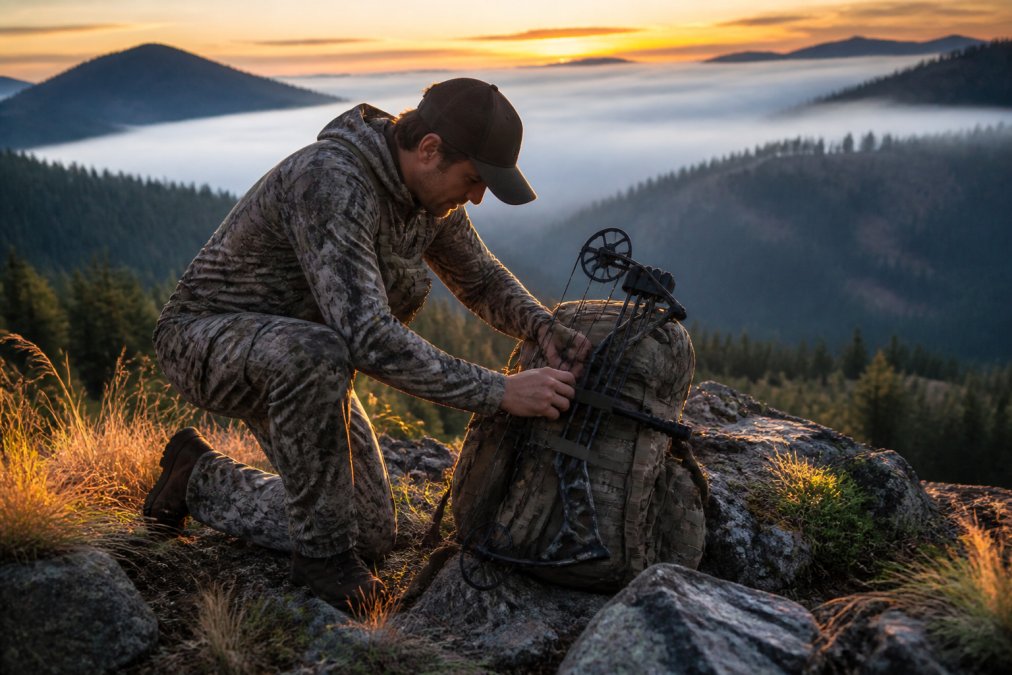
- Locate two load-bearing attachment points on your pack: one high near the shoulder strap, one lower on the side or rear panel.
- Thread the sling's adjustable strap through the upper point first, keeping the bow's cams facing away from your body.
- Secure the lower connection so the bow sits flush against the pack, not dangling.
- Test the quick-release mechanism with gloves on before you start hiking.
- Walk 50 yards and check for shifting before committing to a full day.
Choosing the Right Attachment Points
The best attachment points distribute weight evenly and keep the bow's limbs clear of your legs. Webbing loops near the shoulder straps work well for the top connection because they sit high and stay stable. For the bottom, a side compression strap keeps the bow from rotating.
What most guides miss is that attachment point choice changes with pack design. A bino harness with integrated webbing offers a completely different anchor geometry than a standard 65-liter pack.
Key Features to Compare in a Lightweight Bow Sling
Weight, protection, and release speed separate a functional sling from a frustrating one, and they trade off constantly. A lightweight bow sling that skimps on cam protection will cost you a string replacement; one that prioritizes armor over ounces will wear you down on long approaches. The trick is knowing which spec numbers predict field performance and which are marketing filler.
| Feature | What to Look For | Why It Matters |
|---|---|---|
| Weight | 5-8 oz total | Below 5 oz, abrasion resistance drops; above 8 oz, you feel it by mile eight |
| Material | Coated nylon, neoprene, or 550 paracord | Sheds moisture, resists brush snagging |
| Quick-release | One-handed, glove-friendly buckle | Fast deployment during stalks |
| Cam protection | Padded or covered housing | Prevents string and cam damage |
| Adjustability | Fits 28-34 in axle-to-axle | Works across your quiver |
| Attachment geometry | Two-point anchor | Spreads load, reduces sway |
Weight, Materials, and Weather Resistance
Ultralight slings typically land between 5 and 8 oz, and that range is not arbitrary. Below 5 oz, thin webbing frays against granite and deadfall; above 8 oz, you are carrying a sling heavier than most of your kill kit, which runs 6-10 oz.
Quick-Release, Adjustability, and Protection
Ultralight Bow Hunting Gear: How a Sling Fits Your Kit
A sling is one piece of a broader ultralight strategy, and it only earns its place if it replaces something heavier or solves a problem nothing else can. Weight reduction is cumulative: shaving 6 oz off your sling, 4 oz off your optics protection, and 8 oz off your pack adds up to more than a pound.
Where a sling earns its weight:
- Frees both hands for trekking poles or scrambling
- Keeps the bow off your back where it catches branches
- Reduces shoulder fatigue versus a single-point shoulder carry
- Protects cams and strings during transport
DIY vs. Commercial Slings: What Actually Holds Up
DIY slings built from paracord and hardware can work, and plenty of hunters swear by them for short hikes. The honest limitation is consistency. A hand-tied knot that holds on a two-mile scouting trip may loosen after a full season of rugged terrain and temperature swings.
Pack Integration, Balance, and Safety with a Loaded Bow
Pack integration and bow balance determine whether a sling feels invisible or miserable by mile five. A bow mounted too high throws off your center of gravity; mounted too low, it catches your legs on steep descents. These details decide whether you finish the approach or fight your gear the whole way in.
How Sling Geometry Interacts With Frame Packs
Most sling guides treat the sling in isolation. In practice, it is a bridge between your bow and a specific pack, and the pack's frame, hipbelt, and compression straps dictate where that bridge can attach. Three pack archetypes change the math:
- External-frame packs with vertical stays give you rigid, high anchor points near the top of the frame. A bow slung here rides high and clear of your legs, but it raises your center of gravity and can catch low branches.
- Internal-frame packs with a load-lifter and hipbelt put the stable anchor points at the shoulder strap junction and the side compression straps. This is the most common backcountry setup and the one most slings are designed around.
- Bino harnesses with integrated webbing offer a chest-level anchor that keeps the bow accessible and balanced, but the harness must be rated for the load, a lightweight harness with thin webbing will stretch under a 4-5 lb bow.
Center of Gravity and Bow Balance
A compound bow weighs roughly 4-5 lb rigged, and where you hang that weight changes how the load feels. Two-point attachment spreads the bow's mass across the pack and reduces the pendulum sway that causes shoulder fatigue; one-point attachment concentrates the load and lets the bow rotate, which is why single-strap shoulder carries get uncomfortable fast.
Safety Protocols for a Loaded Bow
Safety protocols for a loaded bow deserve more attention than they get. The core rule: transport with the bow unloaded and the release stowed. An arrow nocked in a sling is one you cannot fully control, and backcountry terrain, loose scree, deadfall, steep sidehills, is exactly where a snag or fall turns a controlled carry into an accident.
A workable protocol:
- Unload the bow before attaching it to the sling. No arrow on the string during transport.
- Stow the release in a pocket, not on your wrist, so it cannot catch on brush.
- Check both attachment points at every rest stop, buckles can work loose over miles of vibration.
- In thick brush or on technical scrambles, consider removing the bow entirely and hand-carrying it rather than risking a snag that could damage the cams.
- Never leave a loaded bow unattended in a sling, even for a short glassing session.
Frequently Asked Questions
Are bow slings worth it for backcountry hunting?
For long hikes through rugged terrain, a bow sling keeps your hands free for trekking poles, glassing, or scrambling. The weight penalty is minimal. Slings also protect cams and strings from brush and rocks. Some hunters prefer strapping the bow directly to their pack for very long approaches, but a dedicated lightweight sling offers faster access when a shot opportunity appears.
What is the lightest way to carry a compound bow while hiking?
The lightest option is a minimalist sling that attaches to your existing pack or bino harness webbing. Avoid bulky padded cases unless you need maximum protection. Ultralight bow hunting gear philosophy favors simple, multi-use attachments over dedicated heavy carry systems. A lightweight sling plus your current pack keeps total weight down and maintains quick access.
How do you attach a bow to a backpack for long-distance trekking?
Most lightweight slings use a loop or strap that threads through your pack's compression straps or daisy chains. Attach the sling to the bow's riser or limb, then clip or tie it to the pack so the bow sits vertically or diagonally behind your shoulder. Test the setup on a short hike to ensure it doesn't shift. For hands-free carry, a pack-attached sling design keeps the bow secure without bouncing.
Do bow slings interfere with quick target acquisition?
A well-designed sling with a quick-release mechanism lets you detach the bow in seconds. Forum users on Rokslide and ArcheryTalk note that slings with simple clips or hooks allow fast access during stalking. Practice releasing the bow with gloves on before your hunt. If the sling requires untying knots, it will slow you down. Look for a system that stays attached to the bow but releases from the pack quickly.
Finding gear that disappears into your kit instead of demanding attention is the real challenge of backcountry hunting. LDH Outdoors builds hand-tied slings that attach to the backpack or bino-harness webbing you already carry, keeping your bow secure and your hands free without adding a new system to learn. At 6.4 oz and backed by a 4.5-star rating from 12 customer reviews, it is the lightest and simplest option we make. Get started with LDH Outdoors and carry your bow the way the hunt demands.


