

Is Lightweight Gear for Elk Hunting Worth It?
Lightweight gear for elk hunting cuts pack weight without cutting capability. Compare real weights, costs, and loadouts for backcountry elk hunters.

In this article
Last Updated: October 29, 2026
Quick Summary
Lightweight gear for elk hunting is worth it when the weight savings are real and durability holds, since pack, boots, shelter and sleep system carry the biggest fatigue cost. A realistic base weight target is the mid-teens to low twenties of pounds, with the pack itself at 3-5 lb.
- Elk101 recommends a pack of at least 4,000 cubic inches for a five-day stay, ideally 4-7 pounds empty.
- Add food at roughly 1.5-2 lb per day and water at about 2 lb per quart.
- A trekking-pole tarp or lightweight two-wall tent can cut 2-3 lb versus a freestanding tent.
- A stiffer boot weighing 8 oz more per pair is often the lighter choice over a five-day hunt.
- The Backpack Bow Sling runs $29.95 and attaches to most backpacks and compound bows.
Table of Contents
- What Counts as Lightweight Gear for Elk Hunting
- The Elk Hunting Gear List: What Earns Its Place in Your Pack
- Backcountry Elk Hunting Gear: Layering for September Through November
- Choosing an Elk Hunting Backpack by Load, Not by Liters
- Ultralight Hunting Gear: Where Weight Savings Pay Off and Where They Don't
- Pack-Out Weight and Meat-Hauling Strategy
- Build Your Lightweight Loadout at LDH Outdoors
- Frequently Asked Questions
What Counts as Lightweight Gear for Elk Hunting
Lightweight gear for elk hunting is any equipment load built to keep your total pack weight down without sacrificing the function you need on a backcountry hunt.
The benchmark most hunters use comes from Elk101's five-day backcountry checklist, which recommends a pack of at least 4,000 cubic inches for a five-day stay, ideally weighing 4-7 pounds empty. That single number tells you something important. Your pack is a tool, not a trophy. If it eats 8 pounds before you've loaded a thing, you've already lost.
A common mistake is chasing the lowest number on every spec sheet. Lightweight gear only works when the savings are real and the durability holds. Below, we break down what earns its place, where weight savings pay off, and where they don't.
The Elk Hunting Gear List: What Earns Its Place in Your Pack
An elk hunting gear list should be built around three questions: will I use it, will it survive, and what does it weigh. Anything that fails the first question is dead weight, no matter how clever the marketing.
Shelter, Sleep System, and Cook Kit
Your shelter and sleep system are usually the heaviest block after your pack itself. A lightweight tent or tarp setup, a sleeping bag rated for the season you actually hunt, and a small stove make up the core.
The cook kit is where hunters overpack most often. One pot, one stove, one fuel canister, one spork. That's the whole list.
Bow Carry and Release Systems
Bow carry is the piece most gear lists skip, and it's the one that changes how a hunt feels.
Our Backpack Bow Sling is the lightest and simplest bow sling on the market. It attaches to the webbing of most backpacks or bino-harnesses, hangs your bow vertical, and releases with a pull of the cord when you need it in hand.
Backcountry Elk Hunting Gear: Layering for September Through November
Backcountry elk hunting gear lives or dies on your layering system, because mountain weather in September and November are two different sports. Gear choices should be based on the hunt itself, and lighter-weight pants and shirts with a merino-wool base layer are a common choice for September elk hunting.
Build layers in three blocks:
- Base layer: merino or synthetic thermal underwear, no cotton
- Mid layer: a lightweight insulated jacket or fleece for glassing sits
- Outer shell: waterproof, breathable rain gear that packs small
Early season means you're hiking hot and sitting cold. Late season means cold weather insulation matters more than breathability. Quiet fabric in the outer layer matters more than most hunters admit.
Choosing an Elk Hunting Backpack by Load, Not by Liters
An elk hunting backpack should be chosen by the load you'll actually carry, not by the liter count on the tag. Capacity gets the headlines. Load capacity and how the frame carries weight decide whether you finish the hike. The practical way to choose is to build a base-weight budget first, then pick the pack that carries that budget plus meat.
Start with a base-weight budget
Base weight is everything you carry except food, water, and worn clothing. It is the number you can actually control, and it is the number that separates a comfortable five-day pack from a grind.
Here is a representative item-by-item budget for a five-day backcountry rifle hunt. Weights are typical ranges, not guarantees, because the exact model you choose will move each line:
| Item | Typical Weight | Notes |
|---|---|---|
| Pack (empty) | 3-5 lb | Frame and hip belt are worth the weight |
| Shelter | 2-4 lb | Tarp or lightweight tent with stakes |
| Sleep system (bag/quilt + pad) | 3-5 lb | Match rating to season |
| Cook kit (pot, stove, fuel, spork) | 1-1.5 lb | One pot, one canister |
| Water storage and filter | 0.5-1 lb | Capacity plus treatment |
| Clothing carried (insulation + shell) | 3-5 lb | Excludes worn layers |
| Optics and rangefinder | 1.5-3 lb | Binos, harness, rangefinder |
| Game bags | 0.5-1 lb | Breathable, sized to quarters |
| Safety, repair, navigation, communication | 1-2 lb | Do not cut this line |
| Misc (headlamp, cord, tags, toiletries) | 1-2 lb | The line that quietly grows |
| Base weight total | 17-30 lb | Before food and water |
Add food at roughly 1.5-2 lb per day and water at about 2 lb per quart, and a five-day trip lands in the 30-45 lb range before any meat.
Match the pack to the hunt scenario
| Hunt Type | Typical Load | What Matters Most |
|---|---|---|
| Day hunt from camp | 20-35 lb | Comfort, quiet access, small profile |
| 3-5 day backcountry | 40-55 lb | Frame, hip belt, base weight |
| Pack-out with meat | 60+ lb | Load lifters, frame rigidity, hip belt |
For a five-day stay, Elk101's 4,000-cubic-inch floor is a reasonable starting point. Just remember that a pack that carries 50 pounds well beats a lighter pack that carries 50 pounds badly. A 4 lb pack with a real frame and a load-rated hip belt will out-carry a 2.5 lb ultralight pack once you add a quarter, and the difference shows up on the second trip out, not the first.
The pack-out test
The best way to choose is to load the pack before you buy it. Put 50 lb in it, sandbags, water jugs, or your actual gear plus a dummy load, and walk a steep mile. Check three things: whether the hip belt carries the weight instead of your shoulders, whether the frame stays rigid when you lean forward, and whether the load lifters actually lift. If you want a system for loading it, our guide to organizing a hunting backpack walks through it step by step.
Ultralight Hunting Gear: Where Weight Savings Pay Off and Where They Don't
Ultralight hunting gear pays off most on your feet and your back: boots, pack, shelter, sleep system. Those four items carry the biggest weight and the biggest fatigue cost. Saving two pounds there beats saving eight ounces on a gadget. But "lighter is better" stops being true at a predictable set of failure points, and the hunters who get in trouble are usually the ones who cut weight without knowing which trade-off they just accepted.
The weight-to-fatigue math that actually matters
A pound on your feet costs more than a pound on your back.
On your back, the savings that matter are the ones you carry all day, every day. A shelter that saves 1.5 lb is worth more than a headlamp that saves 2 oz, because you carry the shelter for the whole trip and the headlamp weight is trivial either way.
Where weight savings are worth it
- Shelter. A trekking-pole-supported tarp or a lightweight two-wall tent can cut 2-3 lb versus a conventional freestanding tent, and the trade-off is mostly pitching skill and stake selection, not safety.
- Sleep system. A quilt instead of a full mummy bag, and a pad with a realistic R-value for the season, can save 1-2 lb. The trade-off is draft management and comfort, which you can test at home.
- Cook kit. One pot, one stove, one fuel canister, one spork. Dropping a second pot and a folding grill saves close to a pound for almost no loss of function.
Where cutting weight backfires
- Boots. A flimsy boot on rugged terrain costs you an ankle. Buy for mountain terrain and load, not for the scale. A stiffer boot that weighs 8 oz more per pair is often the lighter choice over a five-day hunt because it reduces fatigue and injury risk.
- Rain gear. Thin shells that wet out are heavier in practice than a real waterproof layer, because wet fabric and wet insulation weigh more than the dry version and stop insulating. A shell that keeps you dry at 12 oz beats a 7 oz shell you have to replace mid-trip.
- Insulation for late seasons. A 20°F bag used in a November spike camp is not a weight saving; it is a sleep-debt loan. Match the rating to the season you actually hunt.
Durability: the hidden weight of cheap light gear
The lightest option is not always the lightest load. A shelter that tears on day two, a pack strap that fails under a quarter, or a stove that clogs in cold weather all add weight in the form of backups, repairs, and lost hunting time. When you compare two items, compare them at the same durability tier. A 1 lb tarp that lasts one season is heavier over five years than a 1.5 lb tarp that lasts five.
Pack-Out Weight and Meat-Hauling Strategy
Pack-out weight is the part of the plan most hunters get wrong, because the pack you hiked in with is suddenly 60 to 100 pounds heavier.
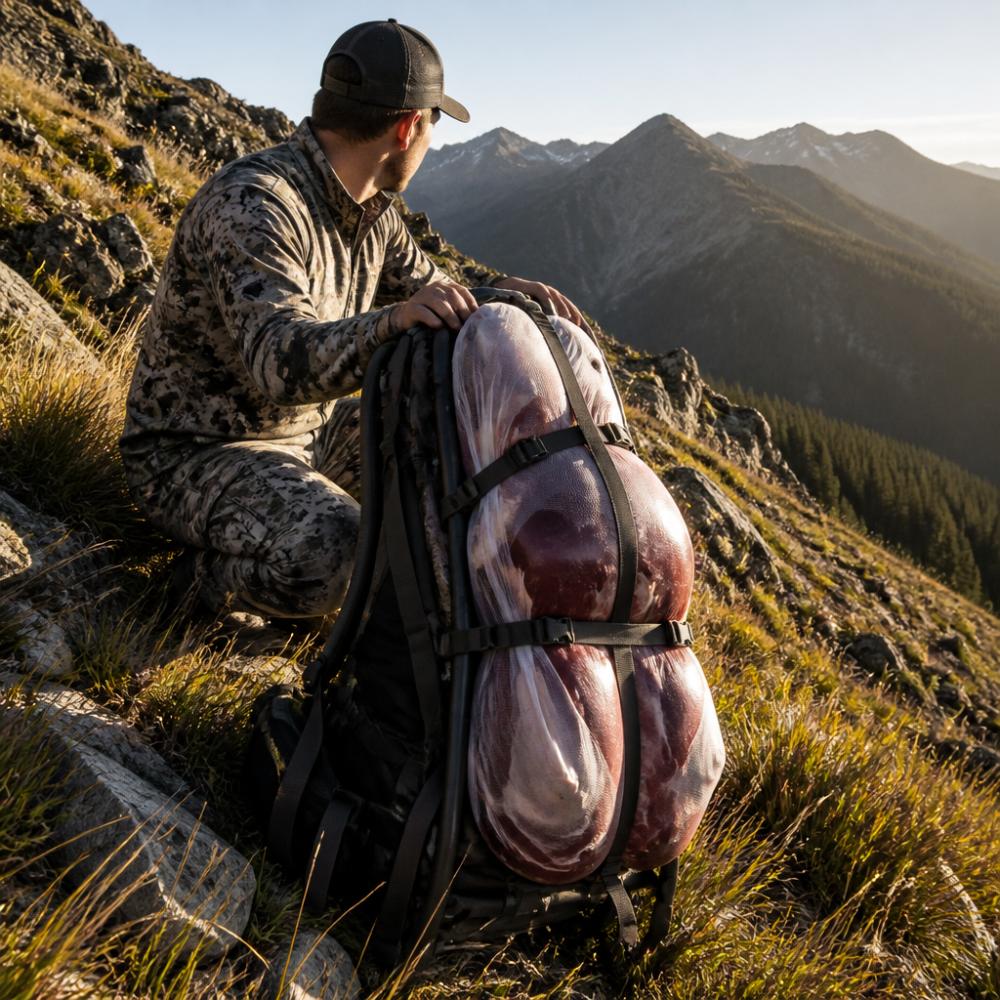
Strategy first. Our 2-pack meat bags pair a quarter bag with a bone-out bag, built from breathable Airwave Ripstop with a DWR treatment and a zipper down one side for loading a bone-in quarter.

Watch out: stuffing warm meat into a non-breathable bag on a sunny slope is how you lose an elk. Airflow and shade are not optional.
Build Your Lightweight Loadout at LDH Outdoors
Lightweight gear for elk hunting isn't about owning the lightest version of everything. It's about spending weight where it buys function and cutting it where it doesn't.
The Backpack Bow Sling runs $29.95 and attaches to most backpacks and compound bows.
Start with the item that changes your hunt the most. Get started with LDH Outdoors and carry your bow hands-free from the trailhead to the shot.
Frequently Asked Questions
How much should an elk hunting pack weigh?
For a five-day backcountry stay, Elk101 recommends a pack of at least 4,000 cubic inches that weighs 4 to 7 pounds empty. That empty weight is your baseline before food, water, and layers go in. A pack in that range keeps the carry system light while leaving load capacity for a quarter. Weigh your pack empty first, then add gear in categories so you know exactly where the pounds come from.
How do you pack light for an elk hunt without giving up capability?
Cut weight in three places: duplicated items, packaging, and hardware. Leave the second knife, the spare headlamp, and the full roll of tape at home, repackage food and first aid into zip bags, and swap steel hardware for aluminum or cord where the load allows. Then check the numbers. Lightweight gear for elk hunting works when every item has one job and no backup twin.
What is the best backpack for backcountry elk hunting?
The right pack depends on your hunt length and whether you are hauling meat. Day hunts from a base camp need less volume, while a five-day backcountry stay calls for at least 4,000 cubic inches per Elk101's guidance. Weight matters too: 4 to 7 pounds empty is the range to aim for. Fit decides the rest. Load the pack with 60 to 70 pounds before the season and walk a few miles to confirm the hip belt carries the weight, not your shoulders.
What clothing should you wear for elk hunting?
Build a layering system rather than buying one heavy jacket. Lighter-weight pants and shirts with a merino-wool base layer are a common choice for September elk hunting, and gear choices should follow the hunt and the weather you expect. Add insulation for late season, plus rain gear that is waterproof and breathable. Quiet fabric matters on close stalks. Test the full system on a training hike so you know how it vents on long climbs and how fast it dries after rain.
Is expensive lightweight gear actually worth the money?
Sometimes. Spend first on boots, pack, and rain gear, where failure ends a hunt. Save on calls and small accessories, where a $29.95 Backpack Bow Sling does a hands-free job without a premium price. Weigh the cost per ounce saved before you upgrade anything.


