

Benefits of Stalking Deer in Open Terrain
Stalking deer in open terrain rewards patience: glass the area for 15 to 30 minutes, route through low ground, and keep your approach downwind.

In this article
Last Updated: November 5, 2026
Quick Summary
Stalking deer in open terrain lets hunters see deer long before the deer see them, because wide sightlines reward patience and careful planning. Success depends on glassing an area before moving, using contour and wind to stay hidden, and approaching slowly on foot.
- Glass the area for at least 15 to 30 minutes before taking a single step toward it.
- Use contour lines and ridges to plan a route that keeps you in low ground as long as possible.
- Keep your approach on the downwind side, and check wind at your position and the deer's location.
- Freeze when a deer looks your way, and resume only when its head goes back down.
- Abort the stalk rather than forcing a low-percentage shot, since rushing causes most failures.
Table of Contents
- Why Open Terrain Changes the Odds for Deer Hunters
- Spot and Stalk Hunting Tactics for Open Country
- Reading Wind, Thermals and Scent Control on Open Ground
- How to Hunt Deer from Ground Level Without Giving Yourself Away
- Bow Hunting Deer from the Ground Without a Blind
- Gear for Mobile Stalking and Carrying Your Bow Hands-Free
- Planning Your Next Stalk Across Open Country
- Frequently Asked Questions
Why Open Terrain Changes the Odds for Deer Hunters
Stalking deer in open terrain gives hunters a real edge when they know how to use it. The wide sightlines that make open country feel exposed to you also let you see deer long before they see you. For many archery hunters, this is the reason they start spending more time on foot and less time sitting in one spot.
Open ground rewards patience. You can watch a whole basin, track deer movement across a field, and pick a route that keeps the wind in your favor. Hunters who try it for the first time often find how much they can learn just by glassing.
The tradeoff is that open country leaves little cover. Every movement matters, and a careless step can end the stalk. That is why the rest of this guide focuses on the methods that make open terrain work in your favor.
Spot and Stalk Hunting Tactics for Open Country
Spot and stalk is the core method for hunting deer across open ground. You find deer from a distance, plan a route, and close the gap on foot. It takes more effort than sitting in a blind, but it lets you hunt animals that would never walk within range of a stand.
Here is the basic sequence most successful stalkers follow:

- Glass the area from a high, quiet point before moving
- Identify deer, their direction of travel, and what they are feeding on
- Pick a stalking path that uses terrain for cover
- Move in short, slow steps and pause often to scan ahead
- Reassess the wind and the deer's behavior at every stop
A common mistake is rushing the approach. Hunters who move too fast tend to bump into deer they never saw. Slow, deliberate movement is what separates a successful stalk from a spooked herd.
Glassing Before You Move
Glassing is the most important part of any stalk. Spend at least 15 to 30 minutes watching a new area before you take a single step toward it. Scan slowly from the near edge to the far edge, then back again, looking for ears, antler tips, or a tail flick.
Glass from a spot that gives you height but still keeps your outline low. Deer often bed in shaded folds or along tree lines, so check those areas twice. Note landmarks, because you will need them to plan your route.
Using Topography and Contour to Stay Hidden
Contour lines on a map show you where the ground rises and falls, and these folds become your best friend in open country. Draws, washes, ridgelines, and tall grass can hide a hunter who moves carefully. Stay below the crest of a ridge when you approach, and use dips in the land to break your silhouette.
Plan your path before you start. A route that looks direct on a map may cross a ridge where you will be skylined. Choose the line that keeps you in low ground for as long as possible.
Reading Wind, Thermals and Scent Control on Open Ground
Wind is the most important factor you cannot see. Deer depend on their noses more than their eyes, so a shift in wind can ruin a stalk in seconds. Open terrain can also create swirling thermals that carry your scent in unexpected directions, especially in the morning and evening.
Check the wind at your position and at the deer's location. Use a light powder bottle or a thin strip of tissue to see how the air moves. Keep your approach on the downwind side of the animals at all times.
Scent control helps, but it is not a magic fix. Wash your clothes in unscented detergent, store them in a sealed bag, and use scent-eliminating products as a backup. The real protection comes from planning routes that keep you upwind.
How to Hunt Deer from Ground Level Without Giving Yourself Away
Ground-level hunting means you stay low and mobile instead of climbing into a tree stand. Your body position, movement speed, and silhouette matter far more than they do from elevated positions.
Many hunters find that moving slowly and stopping often works best. Deer notice motion more than shape, so freeze when a deer looks your way and resume only when its head goes back down. Keep your bow low and close to your body so it does not catch the light or snag brush.
For more detail on staying hidden at ground level, see Quality Deer Management Association guidance on deer behavior.
Bow Hunting Deer from the Ground Without a Blind
Bow hunting from the ground without a blind takes discipline. You rely on terrain, shadows, and slow movement to stay unseen. Shot distances are usually shorter than rifle distances, so getting close without being detected is essential.
Practice drawing your bow from a kneeling or crouched position before the season. You will rarely get a clean standing shot in open country, and fumbling your draw is a common reason stalks fail. Keep your range estimation honest, because misjudging distance is an easy way to wound a deer.
Gear for Mobile Stalking and Carrying Your Bow Hands-Free
Open-country stalking punishes gear that is heavy, noisy, or slow to access. Every item you carry has to earn its place, because you will cover more ground on foot than a stand hunter and you will need your hands free most of the time.
A practical mobile stalking loadout breaks down into four layers:
- Carry system: A pack with a stable hip belt and a bow or rifle attachment that keeps the weapon tight against your back. A loose weapon swings, catches brush, and reflects light.
- Optics: Binoculars on a chest harness, not around your neck. A harness keeps the glass against your chest when you crouch and stops it from swinging into your bow string. A small rangefinder in a hip or chest pocket you can reach without looking.
- Clothing: Quiet fabrics that do not swish against brush, in layers you can shed as you climb. Avoid stiff, crinkly outer shells for the approach; save them for stationary glassing in weather.
- Support and repair: Knee pads for crawling and kneeling, a small headlamp, a wind checker, and a basic repair kit for straps and attachment points.
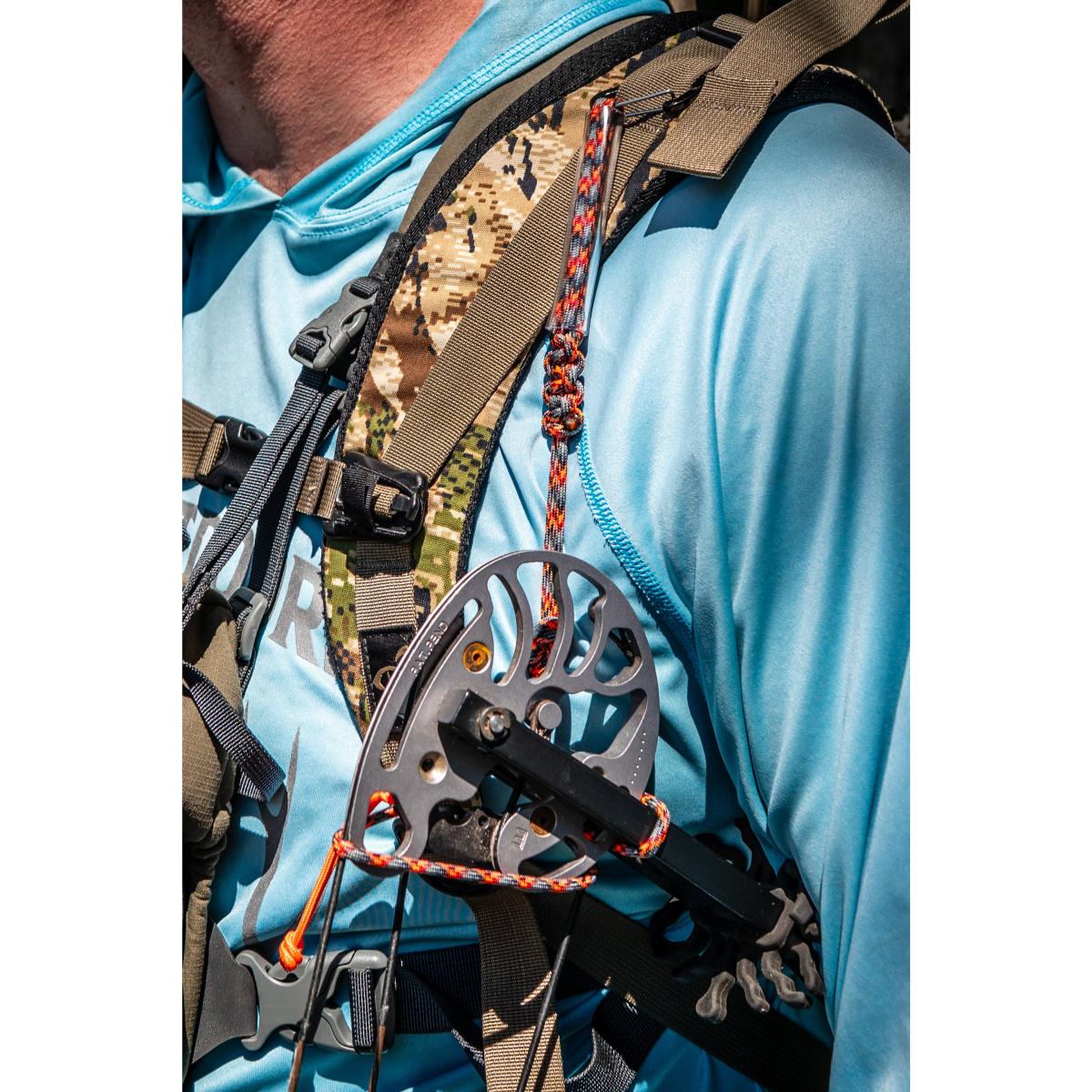
Carrying your bow hands-free is the piece most hunters underestimate. The LDH Outdoors Backpack Bow Sling ($29.95) attaches to most backpacks and most compound bows so the bow can be carried hands-free. Buy the backpack bow sling directly. Learn more about quick-release bow sling benefits for backcountry hunters. It is hand-tied in Oregon.
Watch out: no carrying system can guarantee your equipment stays secured in every condition. Inspect straps, stitching, and attachment points before every hunt, confirm the bow is secure before you walk or climb, and remember you remain responsible for proper installation and use.
The trade-off with lightweight gear is durability and comfort. Ultralight packs carry less weight comfortably, and thin quiet fabrics offer less weather protection. A workable setup for many hunters is a mid-weight pack, a dedicated optics harness, and clothing chosen for quiet movement rather than maximum insulation.
The gear that matters most for open-country stalking, and what each piece is for:
| Layer | What to use | Why it matters |
|---|---|---|
| Carry system | Pack with stable hip belt and bow attachment | Keeps the weapon tight, not swinging |
| Optics | Binoculars on a chest harness | Stays against chest, clear of bow string |
| Clothing | Quiet fabrics in shedable layers | Avoids swishing against brush |
| Support and repair | Knee pads, headlamp, wind checker, repair kit | Helps with crawling, low light and gear fixes |
| Bow carry | LDH Outdoors Backpack Bow Sling, $29.95 | Lets the bow be carried hands-free |
Planning Your Next Stalk Across Open Country
A good stalk starts before you leave the truck, but the planning that separates successful open-country hunters from the rest goes beyond topo maps and a wind forecast.
Plan the approach in stages. Study topo maps, note likely feeding areas and travel routes, and pick two or three possible approaches. Check the forecast for wind shifts, and choose an entry point that keeps the wind in your favor. Then break the stalk into stages: a glassing stage, a long approach stage where you can move at a normal pace behind cover, and a final-approach stage where every step is slow and deliberate. Knowing which stage you are in keeps you from rushing the last hundred yards.
Prepare mentally for the final approach. The last stretch is where most stalks fail, and it is rarely a gear problem. It is impatience. A slow final approach often takes considerably longer than the distance suggests.
Plan the recovery before you need it. Open terrain is hard to navigate in low light and offers few landmarks, so mark your route and the deer's location with a GPS waypoint the moment you decide to shoot. Note the deer's direction of travel and the last landmark you can identify.
Weigh the ethics of the stalk itself. Long-range stalking raises a question every hunter should answer before the season: when do you abort? A stalk that requires a rushed shot, crosses a property line, or pushes deer into an area you cannot recover them from is not worth taking.
Think about your exit as well. Know where you will recover your bow, pack, and any harvested animal. Start small: pick a single area you know well and practice glassing, slow movement, and the staged approach there before you take on larger terrain.
Frequently Asked Questions
Do deer prefer open fields or woods?
Deer use both, and the choice usually depends on food, cover and pressure. Open fields and meadows offer forage, especially in early morning and late evening, while nearby timber or brush gives them bedding cover during daylight. For a stalker, this means the best open-terrain stalks often target the edge where a field meets cover, because deer move between the two. Glass the transition zone first, note travel routes, and plan your approach so you stay downwind and out of sight until you are within bow range.
What is the best time of day to attempt a stalk in open country?
Early morning and the last hour before dark are the most productive windows, because deer leave bedding areas to feed and move between food sources. Midday stalks can still work on overcast days or in terrain where deer bed in open pockets of shade. Open country gives you long sightlines, so start glassing before first light, plan your approach while the animals are feeding, and be ready to hold still when a deer looks up. Watch wind shifts closely, since thermals change direction as the sun rises and sets.
What gear is essential for successful ground-level deer stalking?
Good optics for glassing, a bino harness or backpack system that keeps your hands free, and clothing in muted, earth-tone colors are the core essentials. A wind indicator such as a small bag of powder or thin feathers helps you track air movement at your position. For bow hunters, a hands-free bow carrier like the LDH Outdoors Backpack Bow Sling ($29.95) keeps your compound bow secure while you crawl, climb and glass, so you can move more quietly and keep both hands ready. Pack water, a rangefinder and a small game bag for field care.
Is stalking deer in open terrain more effective than using a tree stand?
Neither method wins in every situation. Stalking in open terrain lets you cover ground, pick a specific animal, and adjust to changing wind and deer movement, which a tree stand cannot do. A stand suits stable patterns around a known feeding area, while stalking rewards hunters who can read terrain and move carefully. Many experienced hunters combine both, scouting open country on foot and placing a stand or sit on the funnel they discover.


