

Bow Spider Alternative for Mountain Hunting
Bow spider alternative: Explore practical bow carrier alternatives for mountain hunting.

In this article
Table of Contents
- Why Bow Spider Alternative Solutions Matter for Mountain Hunting
- How to Carry a Bow While Hiking: Core Carrying Methods
- Backpack Bow Sling: The Lightweight Alternative
- Compound Bow Carrier for Hunting: Comparing Your Options
- Bow Spider vs. Bow Sling: What You Actually Need to Know
- Common Mistakes to Avoid When Choosing a Bow Carrier
- Frequently Asked Questions
Last Updated: October 11, 2026
Why Bow Spider Alternative Solutions Matter for Mountain Hunting
Carrying a compound bow while hiking steep terrain requires balancing security, speed of access, and hands-free movement. A bow spider alternative for mountain hunting solves a real problem: most hunters need their hands free for scrambling, glassing, and navigating rough ground, but they also need their bow accessible within seconds when a stalk turns into an opportunity.
The challenge isn't finding a way to carry a bow. It's finding a system that doesn't shift, doesn't slow you down, and doesn't compromise your ability to move safely on uneven terrain.
A bow spider alternative for mountain hunting typically addresses three core needs: secure retention during climbing and scrambling, quick one-handed release when you need to draw, and minimal bulk that won't catch on brush or throw off your balance on steep slopes. The right system lets you focus on the hunt instead of constantly adjusting your gear.
How to Carry a Bow While Hiking: Core Carrying Methods
The fundamental question is whether your bow carrier attaches to your body, your pack, or both. Each approach trades off different things.
Body-mounted systems (belt or hip carry) keep your bow close and accessible but add weight directly to your hips and core. Pack-mounted systems distribute weight across your shoulders and back but require you to remove your pack to access your bow quickly.
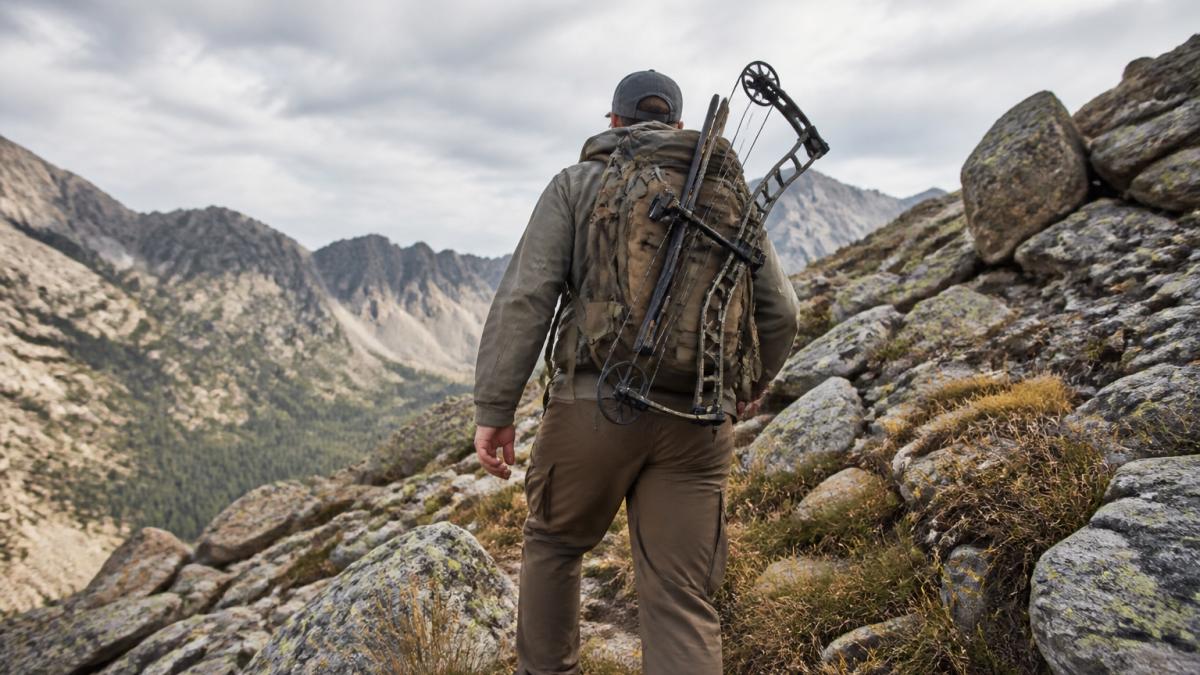
Most serious mountain hunters find that pack-mounted solutions work better for long approaches where you're hiking more than stalking. Once you're in glassing range or actively pursuing an animal, a quick-release system becomes critical.
Hands-Free Carrying for Steep Terrain
Hands-free carrying isn't a luxury on steep ground, it's a safety requirement. When you're scrambling uphill over loose rock or navigating a talus field, both hands need to be available for balance and stability.
A bow sling that attaches to your backpack webbing keeps your bow secured vertically against your pack. This positioning prevents the bow from swinging or shifting as you climb.
The trade-off is access time. A backpack-mounted bow takes 5-10 seconds to deploy because you need to shift your pack position or partially remove it. For a hunter glassing from a ridge and spotting an animal 500 yards away, that delay rarely matters. For a hunter in active pursuit, it's a problem.
Quick Access While Glassing
When you're glassing from a vantage point, your bow sits unused for extended periods. A belt-mounted or hip-mounted carrier keeps it immediately accessible without requiring you to adjust your pack.
The downside is comfort. Hip-mounted systems add pressure to your lower back and hips during long hikes, especially on steep descents. Many hunters find that after 6-8 hours of hiking, the cumulative pressure becomes noticeable.
A hybrid approach works for some: pack-mounted for the approach, then transition to a quick-release belt system once you're in hunting territory. This requires carrying two attachment points, but it optimizes both phases of your hunt.
Backpack Bow Sling: The Lightweight Alternative
A backpack bow sling is fundamentally simpler than other alternatives. It's a strap system that attaches to your existing backpack webbing and holds your bow vertically against the pack. No brackets, no complex hardware, no moving parts.
The LDH Outdoors Backpack Bow Sling exemplifies this approach. At under 4 ounces and priced at $29.95, it's designed to work with most compound bows and most backpacks. The hand-tied construction in Oregon means you're getting a product built by hunters who understand field conditions.

How the Attachment System Works
The sling attaches to your backpack's load-bearing straps or bino harness webbing using simple loops. Once attached, you hang your bow vertically with the limbs pointing down. You then pull the sling under the lower limb and over the cam. The weight of the bow cinches the sling tight against the cam.
To release, you lift the bow's weight slightly, pull the release cord over the cam, and the bow falls free. The entire process takes about 3 seconds.
This simplicity is intentional. Complex systems with quick-disconnects, magnetic mounts, or bracket systems add weight, cost, and potential failure points. A sling works because it relies on tension and the bow's own weight to maintain security.
Security and Retention on Rough Terrain
On scrambling terrain, your bow needs to stay put even when you're moving dynamically. A sling system's security depends entirely on proper cinching and the bow's weight maintaining tension.
The LDH Outdoors sling is designed so the bow's weight pulls the sling tighter as you move. The more your bow shifts, the more tension builds. This creates a self-tightening system that actually improves security under movement.
That said, no carrying system can guarantee retention under every condition. Extreme scrambling, falling, or impacts can dislodge any bow. The user is responsible for regular inspection and proper setup. The product documentation includes safety requirements for a reason, follow them.
Compound Bow Carrier for Hunting: Comparing Your Options
When you're evaluating a compound bow carrier for hunting, you're really choosing between three categories: pack-mounted slings, belt-mounted systems, and integrated backpack solutions designed with bow carrying built in.
Pack-mounted slings are the lightest and most affordable. Belt-mounted systems offer quicker access but add weight and bulk. Integrated backpack solutions are purpose-built but typically cost significantly more and lock you into a specific pack.
Belt and Hip-Mount Systems
A belt or hip-mounted carrier keeps your bow at your side, ready for immediate use. You can draw without removing your pack. This matters when you're actively stalking and expect to shoot within the next few minutes.
The security challenge is that your bow is exposed to brush, branches, and terrain features as you move. A system needs to prevent the bow from rotating or shifting without being so tight that it restricts your movement.
Most belt systems use a combination of straps and retention points. Some use magnetic attachments to hold the bow against your body. Others use quick-release mechanisms so you can detach the bow entirely for certain movements.
Weight ranges from 6 to 16 ounces depending on the system. Comfort varies widely, what works for one body type may feel awkward for another.
Backpack-Integrated Solutions
Some backpacks are designed from the ground up with bow carrying in mind. They feature dedicated attachment points, reinforced webbing, and sometimes built-in retention systems.
The advantage is optimization. Every strap and attachment point is engineered for bow carrying. The disadvantage is cost and inflexibility. If you already own a backpack you like, a purpose-built bow pack requires starting over.
For hunters buying their first backcountry pack, a bow-integrated design makes sense. For hunters with an existing setup, adding a sling to your current pack is more practical.
Bow Spider vs. Bow Sling: What You Actually Need to Know
The Bow Spider is a belt-mounted bracket system that uses mechanical retention to hold a bow at your hip. A bow sling is a strap system that attaches to your pack or harness and relies on the bow's weight to maintain tension.
These are fundamentally different approaches to the same problem, and the choice depends on your hunting style and terrain.
Weight, Bulk, and Mountain Performance
A Bow Spider weighs around 8-10 ounces and adds noticeable bulk at your hip. On steep terrain, that weight on your hip can affect balance and increase fatigue over a long day.
A bow sling weighs 3-5 ounces and distributes weight across your shoulders. On a 12-mile mountain hunt with 3,000 feet of elevation gain, that difference compounds. By mile 8, you'll feel it.
The trade-off is access speed. A Bow Spider lets you draw in 2-3 seconds. A sling requires 5-10 seconds because you need to position your bow before drawing.
For approach hunting where you're hiking to a location and glassing, a sling wins on weight and comfort. For stalking hunting where you're actively pursuing an animal and expect to draw multiple times, a bracket system wins on speed.
Compatibility and Setup Differences
A Bow Spider requires a compatible belt and works with most compound bows, but setup can be finicky. The bracket needs to be adjusted for your specific bow's geometry, and it can take trial-and-error to get it right.
A bow sling works with virtually any compound bow and any backpack with webbing. Setup is straightforward: attach the loops to your pack, hang your bow, cinch the sling.
This compatibility advantage is why many hunters prefer a sling for mountain hunting. You're not locked into specific gear combinations. If you change bows, the sling still works. If you change packs, the sling adapts.
The LDH Outdoors Backpack Bow Sling is specifically designed for this flexibility. It attaches to standard webbing on most packs and works with most compound bows. No adjustment required beyond the initial attachment.
Common Mistakes to Avoid When Choosing a Bow Carrier
The biggest mistake is choosing based on price alone. A $20 sling that fails mid-hunt is infinitely more expensive than a $30 sling that works reliably.
The second mistake is not testing your system before committing to a hunt. Set up your carrier at home, wear it around your property, practice drawing and re-holstering.
The third mistake is assuming one system works for all conditions.
The fourth mistake is neglecting maintenance and inspection. A sling that worked perfectly in September may have a worn strap by November.
The fifth mistake is ignoring fit. A hip-mounted system that doesn't fit your frame creates pressure points and fatigue.
Choosing the right bow spider alternative for mountain hunting comes down to matching your gear to your hunting style.
The LDH Outdoors Backpack Bow Sling delivers the lightweight, simple approach at $29.95.
Frequently Asked Questions
What is a good alternative to the Bow Spider for mountain hunting?
A backpack bow sling offers a lightweight, simple alternative that attaches directly to your existing pack or bino-harness webbing. Unlike rigid carriers, it weighs minimal ounces and cinches your bow vertically against your body using tension from your bow's weight. For hunters prioritizing simplicity and minimal bulk on steep terrain, a hand-tied sling provides hands-free carrying with quick-release capability, all without the complexity of a dedicated mounting system.
How do you carry a compound bow while hiking uphill?
Hands-free carrying works best on steep climbs. Attach a bow sling to your backpack's shoulder strap webbing, hang your bow vertically, and slide the sling under the lower limb, then over the cam. Your bow's weight creates tension that secures the sling automatically. This method keeps both hands free for scrambling, using trekking poles, or catching yourself on steep pitches. The bow stays tight against your pack frame and won't shift during climbing.
Is a backpack bow sling better than a Bow Spider?
It depends on your priorities. A backpack bow sling ($29.95) is lighter, simpler, and costs significantly less. It attaches to existing gear and requires no dedicated mounting hardware. A Bow Spider offers more structure and may feel more stable to some hunters. The trade-off: a sling demands you already own a compatible pack or harness, while a Bow Spider is a standalone system. For minimalist backcountry hunters, the sling's weight savings and simplicity often outweigh the Bow Spider's rigid design.
How do you keep a bow accessible while hiking to a hunting spot?
Position your bow carrier on your pack's shoulder strap or chest harness so your bow hangs vertically at your side, not on your back. This placement lets you draw it quickly when you spot game, without removing your pack. A bow sling's release cord should point backward toward you for one-handed release. Practice the motion at home so you can execute it smoothly in the field. Quick access matters more on stalks than on long approach hikes.


